The Orwellian TrapWhy Putin Cannot Afford to Win
"A peace that was truly permanent would be the same as a permanent war."
George Orwell, Nineteen Eighty-Four (1949), Part Two, Chapter IX
Vladimir Putin is caught in a trap of his own making. He cannot afford to lose his war in Ukraine. Everyone understands that. What is less understood is that he cannot afford to win it either.
If Putin's real goal is to preserve his rule and the legacy he has written for himself, losing is fatal and winning only postpones his decline. A win leaves him a war economy with no off switch, a reconstruction bill no one will pay, and no base of trust in the world. It leaves Russia drifting toward a larger, more frigid version of North Korea, and toward perhaps a generation of subordination to China. His oligarchs and his people get no peace dividend in the Western sense. They will be left behind in today's technological revolution. Time is not on his side.
So the safest course left to him is the one that does his country the most harm: a war that never quite ends and a peace that never quite begins. George Orwell described that condition more than seventy-five years ago. It deserves a name of its own, the Orwellian Trap, and in its own way it is as devastating as the better-known Thucydides Trap.
Two Traps
Graham Allison gave the foreign policy world the Thucydides Trap: the danger that arises when a rising power threatens the position of a ruling one. He drew it from Thucydides's line that "it was the rise of Athens, and the fear that this inspired in Sparta, that made war inevitable." Allison found 16 such cases over five centuries, and 12 ended in war. That trap sits between two countries.
The Orwellian Trap is different. It sits inside one country, between a ruler and his own people. It catches a leader whose survival has become tied to a war he can neither afford to lose nor afford to win. The Thucydides Trap risks a great war. The Orwellian Trap produces a lost generation.
The trap derives from Orwell’s book Nineteen Eighty-Four. In Part Two, Chapter IX of the novel, Winston Smith reads a forbidden book, attributed to the regime's enemy Emmanuel Goldstein, in which the war among the superstates is never meant to be won. "The war is waged by each ruling group against its own subjects," Goldstein's book explains, "and the object of the war is not to make or prevent conquests of territory, but to keep the structure of society intact." Its economic purpose, the same chapter says, is "to use up the products of the machine without raising the general standard of living."
The point is a narrow one: Orwell identified a real-world trap, one just as unfathomable to the liberal thinker as Thucydides's. He saw that a ruling group can come to benefit more from the condition of war than from victory or peace. That does not prove anyone planned it. It does mean they have little reason to end it.
Dead Man Walking
The losing side of the trap needs little discussion. Leaders forced from power by irregular means are very often punished with exile, prison, or death, and defeat in war makes that kind of exit more likely. Putin watched Gaddafi's end in 2011 and, by most accounts, has never forgotten it. A Putin who loses in Ukraine is a dead man walking, in fact or in history: the leader who spent roughly 1.4 million Russian casualties, killed, wounded, and missing, to lose a country he insisted was never really a country. That much is obvious. The harder question is what happens if he wins.
What Winning Buys
Why dwell on winning? A working life spent as an investor in venture capital and private equity, an investment and merchant banker, a CPA, and a valuation professional brings many lessons. It is not if you will lose money; it is when and how much. If it is possible to lose more money than you invest, you will. Cultivating your winners and culling your losses is how you really win. Good management teams and bad ones show themselves in time. The first question in any business investment deal is simple: after the deal closes, what does the buyer actually own, and what will it produce? Asked about Vladimir Putin's war in Ukraine, that question has no good answer.
Suppose Putin gets most of what he says he wants. Ukraine survives on paper but is subordinate in practice. Russia keeps the territory it holds, Kyiv stays out of NATO, and the Kremlin declares that Russia has restored its place as a great power. Victory has been achieved. It will now be defended indefinitely.
What has he actually bought?
Anyone who has been involved in competitive bid acquisitions knows the winner's curse. When the true value of a prize is uncertain, the winning bidder is often the one who overestimated it most, and the prize turns out to be worth less than the price paid. Putin has bid for Ukraine with a generation of young men, his country's savings, and much of its future. Whatever he takes home will not be worth the bid.
Look at the cost. The Stockholm International Peace Research Institute estimates that Russia spent about $190 billion on its military in 2025, or 7.5 percent of GDP and 20 percent of all government spending, the highest share SIPRI has recorded for Russia. The value of destroyed equipment, infrastructure, and lost population remains to be determined. Demographically, Russia was already a civilization in decline: an ageing population, birth rates below replacement, and people moving only one way, out. When people cannot fairly vote at the ballot box, they vote with their feet and take as much of their wealth with them as they can.
To an accountant, a missile is a capital expenditure with no salvage value and no future cash flow. It counts toward GDP the year it is built. Then it is fired, destroyed, or stored. The jobs are real, but nothing accumulates. Goldstein's book in Nineteen Eighty-Four describes the problem exactly: how "to keep the wheels of industry turning without increasing the real wealth of the world." Even the wartime boost has faded. The Bank of Finland's research institute expects Russian growth of about 1 percent this year and about half a percent in 2027 and 2028.
Then the shooting stops and the real bills arrive. A war economy has no off switch. Cancel the defense orders and plants close in towns that have lived on them for years. Keep the orders coming and the civilian economy keeps starving. Veterans – many recruited from prisons and then subjected to the dual brutalities of Russian military culture and the war in Ukraine - will expect pay, care, and work. If they don’t get it they will return to their criminal roots, having developed new criminal networks and become experts in mindless violence. Defense workers will expect their jobs. Families will expect the better life that victory was supposed to bring. The postwar United States was the exception. No longer needed as the Arsenal of Democracy, its factories intact and its sons coming home, it became the engine of reconstruction. A true world economic power was born. Russia is no postwar United States. And whatever ruined ground Russia keeps, Russia owns. Holding territory does not make its people loyal, and it does not make the territory pay for itself.
No Marshall Plan
Another factor is decisive. No one will be willing to pay to rebuild what Russia has broken, and Russia cannot pay for it itself.
After 1945, the Marshall Plan helped pay for Western Europe's recovery, about $13.3 billion over four years. This time there will be no Marshall Plan for Russia, and none from Russia. The West will not finance the rebuilding of land it regards as occupied, and Russia cannot afford America's 1948 role.
The draft budget for 2027 to 2029 sets aside about 865 billion rubles, roughly $10 billion over three years, for the "restoration" of the four annexed regions. The World Bank and its partners put Ukraine's rebuilding needs at $588 billion over ten years. Only part of that damage lies in land Russia holds, but the gap is still enormous.
If the rebuilding of civilian assets fails, the conquered economy does not grow. If it does not grow, it cannot pay taxes, attract investment, or support its own people, and Moscow must keep sending money. A win adds new mouths to feed and a reconstruction bill, and it adds very little to national product. Moscow could, of course, decline to rebuild and simply garrison the ruins. Then it owns a slum rather than an asset, and the bill still comes due as subsidy, occupation, and resentment. Without reconstruction, occupied Ukraine becomes a permanent wound.
The victory comes with a bill and no revenue. That is why, if he wins, his decline is only postponed.
Moscow Has Run These Numbers Before
This was arguably one of the logics behind the Soviet breakup: Russia could no longer afford the people it ruled. Apart from raw materials and some labor, the satellites and many of the republics were a drain. Economists Michael Marrese and Jan Vanous estimated that Moscow transferred the equivalent of $87 billion, in 1980 dollars, to its Eastern European allies from 1960 to 1980, mainly by selling oil cheap and buying poor manufactures dear. Political scientist Valerie Bunce described the Eastern bloc's evolution "from a Soviet asset to a Soviet liability."
When the Soviet Union ended, Russia shed those costs. Putin has spent twenty years mourning that loss. A win in Ukraine takes part of the burden back: damaged regions, people who depend on Moscow for nearly everything, and no Marshall Plan behind them. That is not rebuilding an empire. It is buying back a liability.
Victory Disease
Richard Lacquement, writing for the Army War College's War Room, finds at least six traps in Thucydides. Two fit Putin. One is victory disease, "grasping for growing policy aims even as battlefield success brings the original aims into reach." The other is imperial overstretch, which brought Athens disaster in Sicily. Putin's aims have grown from "denazification" to the annexation of four regions to a civilizational struggle with the West, on an economy expected to grow about half a percent a year. In business, a good management team takes the write-down; a bad one doubles down. Putin has no board and answers to no market.
Tenant Billionaires
In the West, the end of the Cold War brought a peace dividend because there was somewhere for capital to go: open markets, global supply chains, and a technology boom that rewarded private risk. Russia has nowhere comparable to send it. Much of its reserves are frozen in the West, Western finance is closed, and sanctions relief, when it comes, will be partial and reversible. No serious investor can price relief that the next vote can take away.
Then there are the oligarchs. Forbes counted a record 155 Russian billionaires this year, worth a combined $696.5 billion. They are best described as tenant billionaires. What they hold is there at the state's whim, and Putin has shown more than once that he will take what he wants. Lives, freedom, and wealth.
In 2003 he jailed Mikhail Khodorkovsky, then Russia's richest man, and Yukos was broken up and absorbed by the state oil company Rosneft. Since 2022, the Prosecutor General's office has nationalized about 6.5 trillion rubles, roughly $81 billion, in private assets, including Moscow's Domodedovo Airport. Domodedovo was resold in January for about half the asking price to a buyer that Meduza links to Arkady Rotenberg, Putin's former judo partner.
That is not a capital market. It is a system in which wealth is a privilege, a license that can be revoked. Orwell described it in the same chapter: the regime keeps "even the favoured groups somewhere near the brink of hardship, because a general state of scarcity increases the importance of small privileges." The oligarchs' fortunes are not bets on Russia's future. They are bets on the war and on the man.
The Ones Who Left
A peace economy needs people and capital, and Russia has been losing both since 2022. The Bell, an independent Russian outlet, found that at least 650,000 people who left after the invasion had not returned by mid-2024. Most were 20 to 40 years old, and 80 percent had university degrees. Under a 2023 law, once a man's draft notice is entered in the electronic register, he is barred from leaving the country. A country that must lock its exits to keep its young men has said something about what staying is worth.
The exodus falls on a population that was shrinking before the war, and the war has made it worse. In 2024, Rosstat recorded about 596,000 more deaths than births, a fifth more than in 2023. That count includes soldiers only when their deaths are registered, which can take a long time, especially for the missing, and one Russian demographer estimates the decline would be closer to 500,000 without the war. The money has followed. Torbjörn Becker of the Stockholm Institute of Transition Economics counts $406 billion in net private capital that left Russia between the end of 2021 and mid-2026, with some categories still flowing out at about $10 billion a quarter. His conclusion is the one any investor would reach: "less investment means lower growth."
Left Behind
The world did not wait while Russia went to war. Artificial intelligence, advanced chips, and robotics are this generation's economic contest, and Russia is barely in it. In 2024, Stanford ranked Russia 28th of 36 countries for AI. A country under pressure can learn to build drones. It cannot build a frontier technology economy while its engineers leave, its chips arrive through middlemen, and a third of its federal budget goes to things that explode.
North Korea, the Finished Model
North Korea shows where this road ends. One family has ruled it for three generations, since 1948. In that time it has built nuclear weapons, missiles, and one of the largest armies in the world, and very little of value for its people. The instruments of war keep the regime going. The population is held at a subsistence level, wholly dependent on the state, and access to that subsistence depends on obedience.
Russia is not North Korea and will not become it. Its people are educated, its cities are modern, and its scientific tradition is real. But the direction is the same: an economy organized around the military, a public taught that the outside world is the enemy, wealth that exists at the ruler's pleasure, and a shrinking circle of friends. It is telling that Pyongyang is now one of Moscow's most useful partners, sending troops to fight for Russia.
China is the other half of that future. A war launched to make Russia an independent great power again has made it more dependent on another great power than at any time in its modern history. In 2025 China supplied roughly 90 percent of the sanctioned technology reaching Russia, by a Bloomberg count reported by DW. Russia will remain sovereign on paper. For a generation, more of its real choices may be made in Beijing.
Time Is Not on His Side
Putin turned 74 in October. The 2020 constitutional changes could allow him to stay in office until 2036, when he would be 83. Each year of war deepens the dependence on China, widens the technology gap, and brings closer the question no personal dictatorship can answer in public: who comes next?
So the frozen middle suits him: a ceasefire that is not a settlement, and talks that are always about to begin. Kremlin aide Yuri Ushakov says the date of new talks in Abu Dhabi will depend "in part on battlefield conditions and the broader situation." Orwell would have recognized the phrase.
A real peace would force Putin to wind down a war economy, pay bills he cannot cover, let his people compare their lives with the outside world, and face the question every returning soldier and grieving family will eventually ask: what was it for? The government does not need to persuade people that the war is going well. It needs to persuade them that the war is necessary. Victory would take that argument away.
The Other Side
Others have made parts of this argument, and they are credited in the note below. What this essay adds is the buyer's view after the deal closes: the prize itself is a liability, no one will finance it, and Moscow has carried this kind of liability before and could not afford it.
Mariya Omelicheva makes the case against in War on the Rocks: Putin is not trapped, because his regime can survive a bad outcome if it avoids a fiscal shock and keeps the elite and security services loyal. She may be right that Putin survives. But what keeps the elite paid, the security services funded, and the public quiet is the war footing itself. That is Orwell's point. The regime can endure the century only by making sure the country loses it.
Two Traps, One Choice
The Thucydides Trap is about fear between nations, and if it springs, the world pays. The Orwellian Trap is about one ruler's fear of what peace would reveal. If it holds, his own people pay, year after year, in lives, in talent, in capital that leaves and does not return, and in time they cannot recover. Allison argued that escaping his trap requires leaders on both sides to see it. This one is harder, because the only man who can open it is the one it protects. The West should be wary of any settlement that rewards the frozen middle. In practice that means no front-loaded sanctions relief for a ceasefire that leaves Russia's war economy intact, and no Western money to rebuild land Russia insists on keeping. It should also say plainly that the door remains open to a different Russia after this one.
Note on lineage. Aleksandar Matovski used the same chapter of Nineteen Eighty-Four to explain Putin's war as regime survival. Jack Jarmon calls Putin "a fly caught in amber." Andrew Latham argues that Putin can more easily afford another year of war than the first year of peace, and that winning could leave Russia worse off. The phrase "Orwellian trap" has been used in other senses, for Russian speech law and digital trade. Its use here, as the internal counterpart of the Thucydides Trap, is offered as this essay's own contribution.
The views expressed are solely those of the author, as a private citizen. The author is a trustee of the Army War College Foundation and has taken part in Strategic Studies Institute programs and NATO Defense College working groups on Russia as an invited lay participant. Nothing here was prompted or requested by, or represents the views of, any of those institutions or any other with which he is or has been associated.
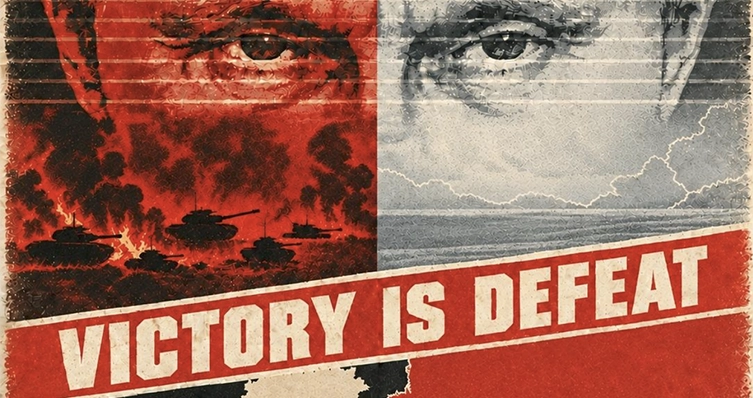
Featured Image: AI-generated illustration (2026), created by the author with AI image tools.