Fault Lines and AftershocksThe Middle East in the Wake of Its Defining Rupture
Read the condensed version of this article.
Abstract
This paper does not argue that the West has won, nor that any single power or ideology has prevailed in the Middle East. Rather, it identifies a set of emerging fault lines that are reshaping the strategic landscape in ways that challenge longstanding assumptions among Western policymakers, among regional actors, and perhaps most significantly, among those who believed that religiously grounded solidarity could function as a durable organizing principle of statecraft. The trends identified here are neither complete nor irreversible. They are, however, consequential enough to warrant serious reassessment of frameworks that have dominated analysis of the region for the past four decades.
The central argument is this: practical state interest and societal pressure are proving stronger than ideological or religious solidarity as determinants of behavior across the Middle East. This is not a Western victory. It is a recognition, still contested and uneven, that the states of the region, including those governed by religious authority, are discovering the limits of theology as foreign policy. Israel has played a complicated role in this process: it has simultaneously weakened the prospects for long-term reconciliation while also degrading Iran and its proxy network in ways that the Arab states of the region could not accomplish on their own. OPEC's declining coherence reflects market forces and diverging state fiscal needs, not a geopolitical defeat. And the westernization visible in Gulf societies is better understood as a pragmatic state-led modernization designed to preserve regime authority than as any form of cultural capitulation to Western norms.
These are emerging trends, not settled outcomes. This paper maps them, examines their drivers, and assesses both their promise and their significant remaining uncertainties.
Introduction: Fault Lines, Not a Finished Map
The image of tectonic plates suggests sudden, irreversible movement. The more accurate image for the Middle East of 2026 is one of fault lines, places where pressure has been building, where the surface has begun to crack, and where the direction of movement is visible even though the ultimate displacement remains uncertain. Fault lines can stabilize. They can also produce earthquakes.
What has become visible since 2023 is a set of pressures that have been accumulating for decades but are now producing observable behavioral changes among the region's key actors. States that once justified foreign policy decisions in terms of religious solidarity are making choices grounded in fiscal survival, regime security, and strategic calculation. An Iran that built its regional influence on the idea that proxy warfare and religious legitimacy could substitute for conventional power has seen that architecture exposed and damaged. A cartel whose members once shared enough common interest to coordinate supply has found those interests increasingly divergent. Gulf societies that once suppressed the aspirations of educated, urbanized, globally connected populations are making room for them, not out of liberal conviction, but out of political necessity.
None of this constitutes a resolution. The Palestinian question remains open and deeply felt. Iran retains the capacity for reconstitution. The Gulf states' political liberalization has not kept pace with their social and economic modernization. And the external powers, the United States, China, Russia, Turkey, continue to compete for influence in a region that still controls a substantial share of the world's energy resources.
This paper proceeds as follows. It examines, in turn, the fragmentation of pan-Islamic solidarity as a foreign policy instrument; the degradation of Iran's regional architecture; the structural weakening of OPEC as a price-setting mechanism; the nature and limits of Gulf state modernization; the emerging but incomplete Arab-Israeli strategic alignment; the challenge of waterway vulnerability and alternative infrastructure; and the persistent military manpower gap confronting Gulf states. It concludes with an assessment of what these trends mean for regional and global stability, acknowledging both the genuine positive developments and the serious risks that accompany them.
Islam Is Not One Thing: The Fragmentation of Pan-Islamic Solidarity
One of the most consequential misunderstandings embedded in four decades of Western policy analysis is the tendency to treat Islam as a unified political force. It is not, and it never has been. The events of 2023 to 2026 have made this undeniable, not because the West has demonstrated it, but because the states and societies of the Muslim world have demonstrated it to each other.
The Russia-Ukraine war and the Israel-Gaza conflict both affected Muslim populations. Neither produced a unified transnational Islamic political response. This is significant not because it vindicates any Western position, but because it reveals something important about how the states of the Muslim world are governing their own interests. Saudi Arabia, the UAE, Turkey, Egypt, and Pakistan each made calculations grounded in domestic political stability, economic exposure, and strategic alignment, not in theological obligation.1
This does not mean religion is irrelevant to politics in the region. It means that the relationship between religious identity and state behavior is far more complex than either Western threat analysts or pan-Islamic advocates have typically assumed. The clerics in Tehran and the ideologists of Hamas operated on the assumption that religion could be converted into strategic solidarity at scale. The behavior of Arab states during the Gaza conflict demonstrated the limits of that assumption.2
Importantly, the Arab states that declined to mobilize religiously around Gaza were not thereby endorsing Israel's conduct. Arab public opinion, as documented by Arab Barometer polling, remained overwhelmingly sympathetic to Palestinians.3 What changed was the willingness of states to translate that sentiment into strategic action, particularly action that would carry costs for regime stability, economic relationships, or bilateral security arrangements. The gap between public sentiment and state policy is itself a fault line, one that has not closed and could widen again under different circumstances.
Iran had positioned itself as the authentic champion of Palestinian resistance, funding Hamas and Islamic Jihad as instruments of strategic pressure while claiming the moral authority of religious solidarity. That claim required Iran to demonstrate the capacity to act on it. When Iran failed to prevent the destruction of its proxy infrastructure, and when it then suffered significant direct military losses, its credibility as a religious-strategic actor collapsed for many of the governments it had sought to influence.4 The lesson drawn by states in the region is not that Islam is unimportant but that Iran had been overstating the extent to which religious framing could substitute for effective strategic capability.
This is a fault line, not a resolution. Pan-Islamic appeals retain mobilizing power at the level of populations. The OIC as an institution remains largely unable to translate those appeals into coherent collective action.5 The gap between the two creates ongoing instability, but it also creates space for pragmatic state-to-state diplomacy that was previously constrained by the costs of appearing insufficiently Islamic.
This argument is consistent with a body of scholarly work that has been developing for more than two decades. Olivier Roy's analysis of post-Islamism describes precisely the phenomenon observed here: the progressive decoupling of Islamic religious identity from political ideology as a governing framework, as Muslim-majority states discover that theology does not produce workable administrative answers to questions of fiscal management, economic development, and security.6 Shadi Hamid offers a more nuanced counterpoint, arguing that political Islam retains genuine popular resonance in ways that Western analysts systematically underestimate, a caution this paper takes seriously in its repeated insistence that the fault lines identified are tendencies, not settled conclusions.7 The distinction between state behavior and mass political sentiment that both scholars identify is precisely the gap this paper attempts to map.
Iran's Strategic Architecture: Degraded, Not Destroyed
For four decades, Iran's grand strategy rested on a network of armed non-state actors, Hezbollah in Lebanon, Hamas in Gaza, the Houthis in Yemen, Shia militias in Iraq, and the Assad regime in Syria, collectively framed as an Axis of Resistance. The strategy was coherent: by projecting power through dispersed proxies, Iran could hold adversaries at risk while maintaining plausible deniability and avoiding direct conventional confrontation.
Between 2024 and 2026, that architecture absorbed severe damage across multiple nodes simultaneously.
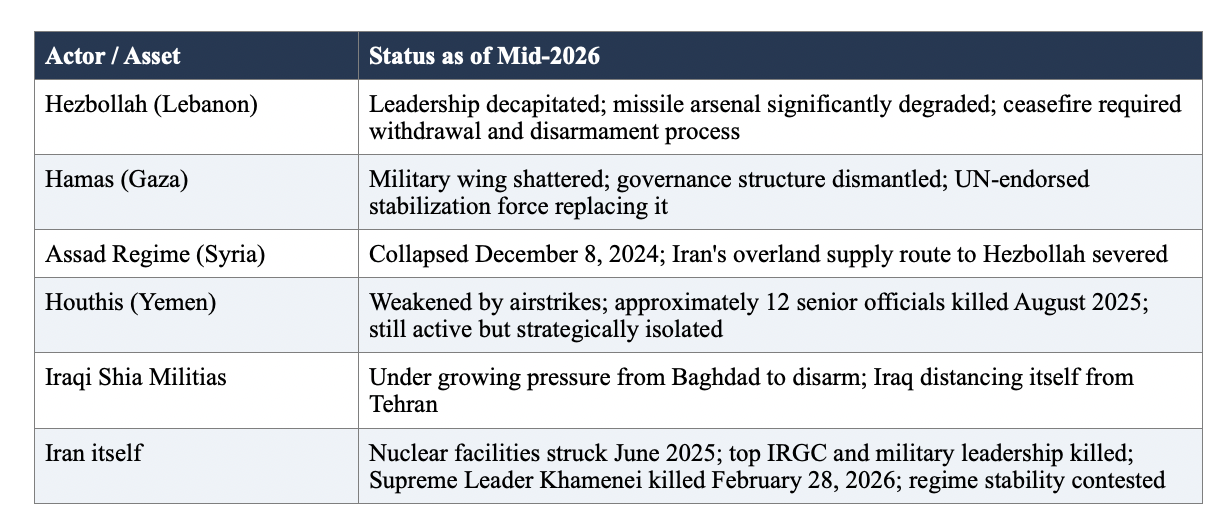
A critical point of clarification is needed here. The degradation of Iran's regional architecture was not something the Arab states of the Middle East could have accomplished on their own. The military operations that destroyed Hezbollah's missile stockpile, killed IRGC leadership, and struck Iran's nuclear facilities were Israeli and American operations. Arab states, including those most threatened by Iran, lack the precision military reach, the intelligence infrastructure, and the domestic political capacity to have undertaken these actions unilaterally. This creates a paradox that this paper does not minimize: Israel's actions have materially advanced the security interests of Gulf Arab states while simultaneously making Israeli-Arab political normalization more difficult in the short term, because Israeli operations have generated Palestinian civilian casualties at a scale that Arab publics find intolerable regardless of strategic alignment at the state level.
On June 13, 2025, Israel launched a major military operation against Iran targeting nuclear facilities, military sites, and regime infrastructure, killing IRGC commander Hossein Salami, armed forces chief Mohammed Bagheri, and IRGC air force commander Amir Ali Hajizadeh, as well as several nuclear scientists.8 The United States subsequently struck the Fordow, Natanz, and Isfahan nuclear sites on June 22. A ceasefire was announced June 24, 2025. Supreme Leader Ali Khamenei was killed in US-Israeli strikes on February 28, 2026.9
These events have left Iran in its most strategically exposed position since the 1979 revolution. But Iran remains a state of 90 million people with significant conventional military capacity, a surviving state apparatus, and a history of strategic patience. The Axis of Resistance has been degraded, not eliminated. Iranian strategy is being reconsidered and reconstituted, not abandoned.10 The fault line is real, but the outcome is not determined.
OPEC: Market Forces and State Fiscal Needs as the Limiting Factor
OPEC's declining coherence as a price-setting cartel is best understood not as a geopolitical defeat but as the product of two converging pressures: the structural difficulty of enforcing cartel discipline when member states have divergent fiscal needs, and the longer-term pressure from global energy transition on the sustainability of a hydrocarbon-dependent economic model.
The cartel's fundamental enforcement problem is not new. OPEC members have cheated on quotas in virtually every period of the organization's history, in the 1980s collapse, in the 1998 price war, through the shale boom years, and again now.11 What is different in the current period is the intensity of the divergence. Gulf states that have invested heavily in economic diversification under programs like Saudi Vision 2030 are increasingly calculating that selling oil now at market-clearing prices, and deploying the revenue into non-oil sectors, is more strategically rational than restricting production to hold prices up in a market where non-OPEC supply (particularly American shale) reliably fills any gap they create.
The UAE's announcement that it would leave OPEC on April 28, 2026, effective May 1, is the clearest expression of this diverging interest.12 Significantly, the UAE's own energy minister stated the decision "was not a political move”, it was an economic strategy shift.13 The UAE wants to maximize oil production while it still has market share, and the OPEC framework was constraining it from doing so.
Several specific data points illustrate the current state of the cartel:
- Oil prices fell approximately 20% in 2025, the steepest annual decline since 2020.14
- Saudi Arabia exceeded its own OPEC+ output target in June 2025, joining the list of quota violators it had publicly condemned.15
- Oil prices touched $60 per barrel in late 2025 for the first time since 2020, even as OPEC+ was unwinding production cuts.16
The IEA projects global oil demand to peak before the end of the decade and then decline, while OPEC's own forecast still anticipates growing demand beyond 2045, a divergence that reflects the deep uncertainty surrounding when and how fast the energy transition will proceed.
The Gulf states' response to this uncertainty is pragmatic: extract and monetize hydrocarbon wealth while investing the proceeds in non-oil economic sectors. Saudi Arabia's Vision 2030, the UAE's diversification programs, and Qatar's LNG-centered strategy all reflect variations on this approach. GCC non-oil GDP growth has been meaningfully positive in 2025, with overall GCC-wide growth of approximately 3.2 to 3.3 percent.17 The transition is incomplete and the timeline is uncertain, but the direction is not in serious doubt.
A reviewer might reasonably ask whether the current period differs from prior OPEC compliance crises, given that the cartel survived the 1985 to 1986 price collapse, the 1998 price war, and the 2014 to 2016 shale supply surge. The argument here is that the UAE's formal exit on April 28, 2026 represents a qualitative departure from past quota disputes. Prior crises involved members cheating within the framework while preserving it. Formal withdrawal removes a founding member entirely, signals that the framework's political and economic costs now exceed its benefits for a key Gulf producer and sets a precedent that other members can follow. The cartel can survive internal cheating; it is harder to survive formal defection by members whose production capacity makes them indispensable to any coordinated output management.18
OPEC is not dead. It continues to function as a forum for oil-producing states to communicate and occasionally coordinate. But its capacity to function as a discipline-enforcing cartel capable of managing global oil prices has been significantly diminished by structural forces, competing state fiscal interests and the long-term trajectory of energy demand, that are unlikely to be reversed.
Gulf State Modernization: Pragmatic, Not Western
The social and economic transformation visible across Gulf states, most dramatically in Saudi Arabia but also in the UAE, Qatar, Bahrain, and Oman, is frequently labeled "westernization." That label requires qualification. What is occurring is better understood as state-directed modernization: a deliberate program by ruling families to extend their regimes' social contract to younger, more educated, more globally connected populations by expanding the scope of what those populations are permitted to do economically and socially, without extending commensurate political rights.
This is not liberalism. It is authoritarian adaptation.
Saudi Arabia's Crown Prince Mohammed bin Salman has since 2017 implemented a series of social reforms that have materially changed daily life for millions of Saudis:
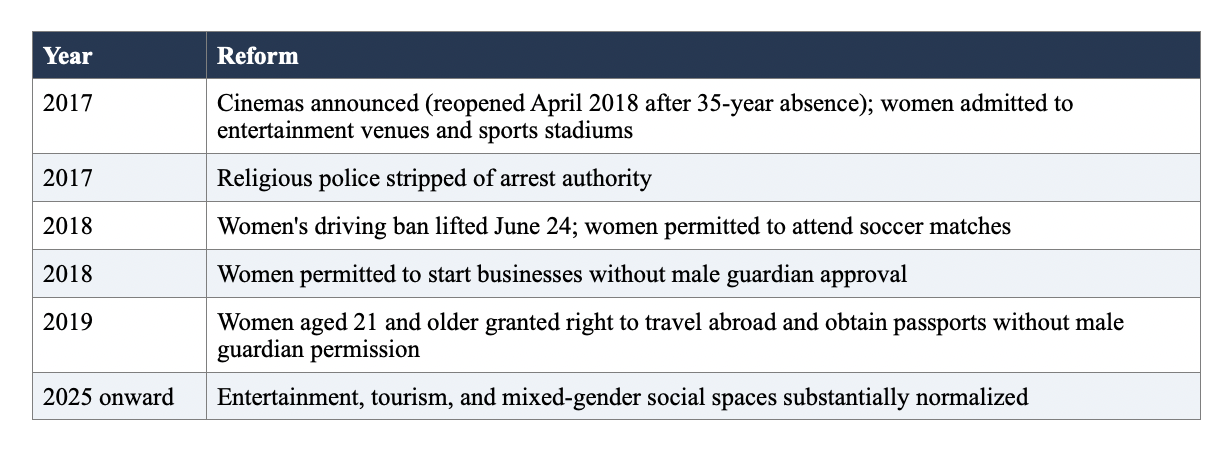
These changes are real and consequential. They are not, however, equivalent to democratization or political liberalization. The guardianship system reforms undertaken in 2019 were specific to travel and passport rights; significant elements of the broader guardianship framework governing marriage and other life decisions remained in place.19 The pace and nature of reform are determined by the ruling family, not by popular demand expressed through representative institutions.
The UAE and Qatar represent more advanced versions of the same model. Dubai functions effectively as a global city-state in social and economic terms. But the political authority of the ruling families in both cases remains absolute.
The practical importance of this trend for regional stability is real. A Saudi Arabia with cinemas, women driving, and an expanding non-oil private sector is more economically diversified, less dependent on religious legitimacy for regime stability, and more integrated into global economic networks than its predecessor. These are stabilizing factors. The long-term fault line, however, is the gap between a modernizing society and a political system that has not kept pace. That gap is manageable for now, particularly with economic growth and expanding social freedoms absorbing the aspirations of a young population. Whether it remains manageable over a decade or two is genuinely uncertain.
The Abraham Accords: Emerging Alignment With Important Limits
The formal Abraham Accords of 2020 established diplomatic relations between Israel and the UAE, Bahrain, Sudan, and Morocco. Saudi Arabia withheld formal recognition, conditioning it on meaningful progress toward Palestinian statehood, a position that remains official Saudi policy.
The operational reality since 2020 has been more complex than the formal diplomatic record suggests, but recent developments also complicate any straightforward narrative of deepening convergence. On one hand, Saudi Arabia and the UAE have both backed the UN-endorsed International Stabilization Force framework for post-Hamas Gaza governance,20 signaling strategic alignment with outcomes Israel sought. Intelligence sharing and security cooperation across the informal Israel-Gulf channel have continued. In November 2025, Kazakhstan became the first country to join the Abraham Accords under Trump's second term, announced at the White House C5+1 summit following a trilateral call with Israeli Prime Minister Netanyahu and Kazakh President Tokayev, representing the framework's first expansion into Central Asia.21 The formalization in early 2026 established a structured partnership focusing on cybersecurity, water management, and critical minerals cooperation.22
On the other hand, the diplomatic trajectory as of mid-2026 is more complicated. Israeli officials have described themselves as "more doubtful" about Saudi normalization following Saudi Arabia's diplomatic shifts toward Turkey and Qatar.23 Prime Minister Netanyahu stated in January 2026 that a formal deal with Saudi Arabia is "not going to be signed any time in the foreseeable future."24 Saudi Arabia continues to insist that formal normalization requires meaningful progress toward Palestinian statehood, and 81 percent of Saudi survey respondents held a negative view of normalization as of mid-2025.25
The honest assessment is this: there is a real, growing convergence of strategic interests between Gulf Arab states and Israel around the shared threat from Iran and political Islam. That convergence has produced genuine cooperation at the operational level. But it has not overcome the political obstacle of the Palestinian question, and Israel's conduct in Gaza has if anything increased the political cost of formal normalization for Arab governments that face populations deeply opposed to it. This is a fault line, not a resolution. The gap between strategic interest and political feasibility remains wide.
A joint Saudi-French initiative to revive a two-state solution framework, and the July 2025 New York Declaration's endorsement of Palestinian statehood principles, reflect the Arab states' attempt to find a path that allows both strategic alignment and political legitimacy.26 Whether that path exists in practice depends heavily on Israeli policy choices that remain contested.
The structural link between Israeli policy and normalization feasibility deserves explicit statement. Formal Saudi-Israeli normalization is not simply blocked by abstract Palestinian sentiment, it is blocked by the specific question of whether Israeli policy on Gaza reconstruction, West Bank settlement expansion, and the political horizon for Palestinian statehood is compatible with an outcome that gives Arab governments domestic political cover. No combination of security cooperation or economic incentives resolves this if Israeli policy continues to foreclose the two-state pathway that Arab publics regard as the minimum condition for their governments' engagement. This is not a criticism of any party; it is the political geometry of the problem.
Waterways, Pipelines, and the Limits of Chokepoint Dependency
The Strait of Hormuz, through which approximately 20 million barrels of oil per day transit, representing roughly 20 percent of global petroleum consumption, has long constituted Iran's most powerful strategic lever short of direct military action.27 By threatening closure, Iran could hold global energy markets hostage without engaging in conventional warfare. The Gulf states understood this dependency and have invested in alternative export infrastructure.
Three pipeline systems currently provide partial alternatives:
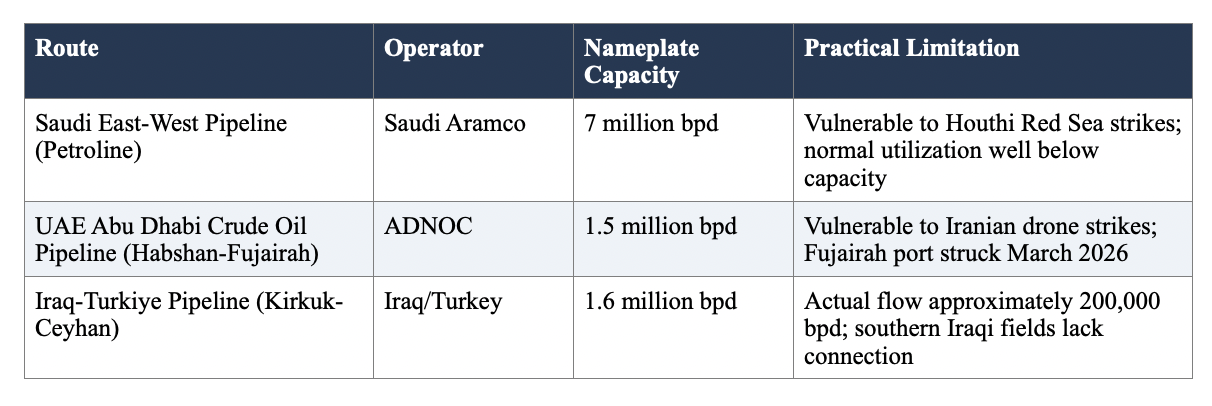
The gap between nameplate capacity and operational reality deserves emphasis. The combined theoretical maximum bypass capacity of approximately 8.5 to 9 million barrels per day is itself less than half of Hormuz throughput. But during the February to March 2026 conflict period, actual utilized bypass flows were reported as far lower, in the range of 900,000 barrels per day at the outset of the crisis, rising toward 2.9 million barrels per day as Saudi Aramco ramped the Petroline.28 Nameplate capacity and real-world bypass capacity are materially different quantities.
Furthermore, these pipelines are land-based and within reach of Iranian missiles and drones, as the 2019 Houthi strikes on Saudi pumping stations and the March 2026 drone strikes on Fujairah demonstrated.29 The infrastructure that would allow Gulf states to bypass Hormuz is itself a target.
Iran's military capacity to threaten Hormuz has been degraded by the 2025 to 2026 military operations. But it has not been eliminated. A reconstituted Iranian state or a successor non-state actor with access to Iranian missile infrastructure could still threaten global energy supply through waterway interdiction. The long-term resolution, if one is achievable, lies in continued pipeline investment, Gulf-wide infrastructure coordination through the GCC, and the diversification of Gulf state economies so that a Hormuz closure becomes a shared economic catastrophe rather than a purely one-sided Iranian weapon.
The Ground Force Gap: Money Cannot Substitute for People
The most structurally significant constraint in the new regional order is one that receives insufficient attention in most commentary: the Gulf states' inability to project credible ground force at the scale that stabilizing a post-conflict regional order would require.
The financial resources are not in question. Saudi Arabia allocated approximately $78 billion to defense in 2025, 21 percent of total government expenditure, placing it among the top ten military spenders globally.30 The UAE's $27 billion defense budget is similarly outsized relative to its population. Cumulatively, the Gulf states have spent hundreds of billions of dollars on advanced weapons systems over the past decade.
The capability gap is not financial. It is demographic and doctrinal.
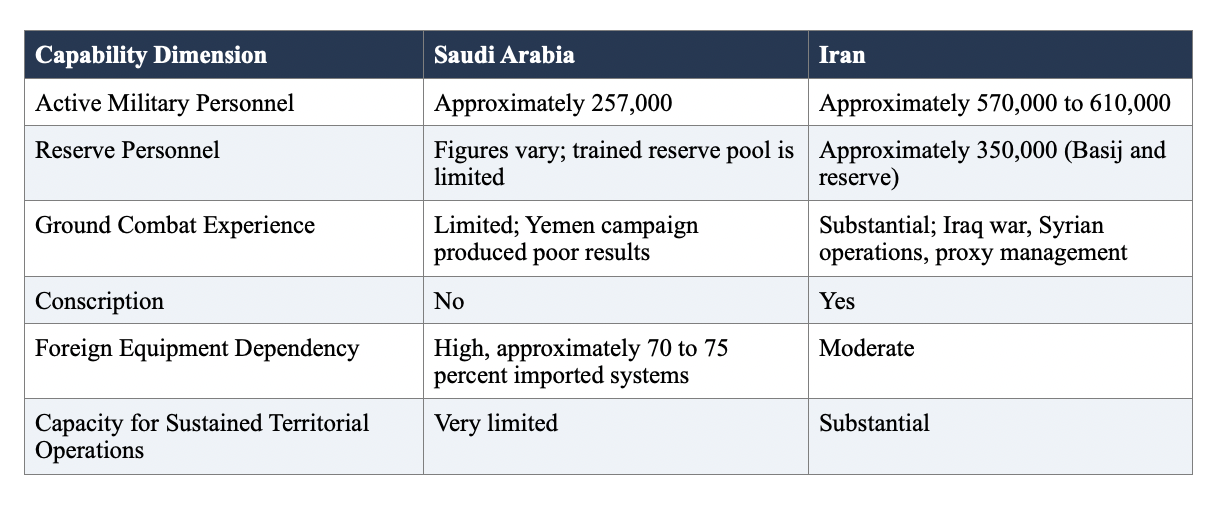
The Yemen campaign is the most instructive recent data point. Saudi Arabia, with its massive defense budget, has been unable in over a decade to defeat the Houthis: a non-state adversary with no air force, no navy, and a small fraction of Saudi Arabia's defense resources. Saudi forces struggled with combined-arms coordination, logistics in austere terrain, and adapting to irregular tactics.31 If this is the performance against the Houthis, the capacity gap against Iran's regular forces, Revolutionary Guards, and dispersed irregular warfare capability is even more pronounced.
The doctrinal point is fundamental: air power and drone warfare can destroy, degrade, and deter. They cannot occupy. The stabilization of post-conflict Iranian territory, the enforcement of post-conflict security arrangements, or the suppression of successor non-state actors in Iran's place would all require ground forces capable of sustained territorial operations. The Gulf states do not currently possess this capability, and their demographic constraints, Saudi Arabia has approximately 19 to 20 million citizens in a total population of 35 million, with the UAE having under 1.5 million citizens in a population now exceeding 11 million,32 mean it cannot be developed at scale through conventional conscription models.
This is the central unresolved tension in the emerging regional order. The Gulf states have the financial resources and the American and Israeli security partnerships to degrade threats they cannot occupy. Degrading Iran's military capacity without the ability to shape what follows creates strategic vacuums that have historically been filled by the next destabilizing non-state actor.
Several partial responses exist:
- Contracted and coalition ground forces. The GCC model of using Pakistani, Sudanese, and other third-country forces supplements but does not replace national ground capability. Their political loyalty is transactional.
- American forward presence. U.S. Central Command, Al Udeid Air Base in Qatar, and CENTCOM's forward infrastructure provide deterrence. But America's willingness to sustain indefinite ground commitments in the Middle East remains domestically constrained.
- Israeli operational capacity. Israel's ground and special operations forces represent the most capable military instrument in the region. The convergence of Israel-Gulf strategic interests creates the possibility of operational coordination, but the domestic political costs of formally acknowledging such cooperation remain high in every Gulf capital.
- Turkish forces. Turkey has demonstrated sustained effectiveness in Syria and Libya and possesses the manpower depth the Gulf states lack. But Turkish and Gulf state interests are not fully aligned, and Turkey's relationship with political Islam creates complications.
None of these options fully bridges the gap. This remains the most significant structural constraint on the emerging regional order.
The 2011 GCC intervention in Bahrain offers a useful calibration point. The Gulf states demonstrated willingness to deploy ground forces in extremis, Saudi Arabia and the UAE sent approximately 1,200 troops to suppress protests threatening the Khalifa government. They were effective at the scale of a small island nation with a population of under 1.5 million. The exercise demonstrated both the willingness to use force for regime protection within the Gulf and the limits of scalable ground force projection beyond it. Bahrain was a manageable operation. Iran, with its 636,000 square miles of territory, 90 million people, mountainous interior, and battle-experienced irregular forces, is an entirely different proposition.
The Nuclear Dimension: A New Fault Line
Any assessment of the region's structural fractures must now account for a dimension that has moved from theoretical to concrete within a matter of days. Saudi Crown Prince Mohammed bin Salman has for years stated plainly that if Iran acquires nuclear weapons, Saudi Arabia will pursue them as well. In a 2018 CBS News "60 Minutes" interview he stated: "Saudi Arabia does not want to acquire any nuclear bomb, but without a doubt, if Iran developed a nuclear bomb, we will follow suit as soon as possible." He reiterated the position in a 2023 Fox News interview with Bret Baier: "If they get one, we have to get one." These are not hedged diplomatic formulations, they are among the clearest public statements of nuclear intent made by any major Arab leader in the modern era, and they are the fact against which the events of July 21 and 22, 2026 should be read.33
On those dates, the Trump administration finalized a thirty-year civilian nuclear cooperation agreement with Saudi Arabia. American firms are set to construct the kingdom's nuclear facilities, and Saudi Arabia is barred for ten years from developing its own enrichment technology or acquiring it elsewhere. Before any enrichment activity begins, a joint US-Saudi team will assess whether it is commercially necessary. On its face, this looks like a constrained, carefully bounded arrangement. Examined more closely, the constraints are narrower than they first appear. Riyadh is not required to sign the IAEA Additional Protocol, the supplementary agreement that grants inspectors expanded, short-notice access. In its place, a bilateral US-Saudi safeguards agreement mirrors the model protocol's structure but omits provisions Riyadh found objectionable, reportedly including inspection access tied to Mecca and the royal residences. The comparison to the UAE's 2009 "gold standard" agreement, which did include the Additional Protocol, is instructive: the Saudi deal represents a meaningful step back from the nonproliferation discipline that has governed prior US civil nuclear arrangements in the Gulf. Congressional unease has already surfaced, and the deal still requires approval from the IAEA Board of Governors before its terms take effect.34
The region has a documented history of cascading acquisition in conventional weapons and missile technology, and it is reasonable to ask whether nuclear latency could follow a similar logic, though nuclear acquisition carries technical, financial, and legal barriers that conventional and missile proliferation do not. No cascade has yet been observed in the nuclear domain. In the author's judgment, if Saudi Arabia secures a credible path to enrichment capability, even one framed as civilian and delayed a decade, Turkey and Egypt are plausible candidates to seek equivalent standing, though for distinct reasons: Ankara through strategic autonomy, NATO-context positioning, and rivalry with Iran; Cairo through competition with Israel and Arab leadership aspirations, and both would face significant technical, legal, and financial barriers that make any such response uncertain and slow in materializing. This is a directional risk that warrants monitoring rather than a pattern already in evidence, but it is a risk the current agreement does not contain explicit mechanisms to address, though external pressures, including U.S. leverage and economic dependencies, could serve constraining functions.35
A dimension the paper has not yet addressed directly is the political division within the Gulf states themselves, separate from the state-to-state rivalries examined elsewhere. Vision 2030 Saudi Arabia and the UAE have suppressed overt political opposition at home, but suppression is not the same as consensus. As documented elsewhere in this paper and confirmed by Arab Barometer survey data, the normalization track and the Gaza conflict have widened the gap between what Gulf governments are pursuing strategically and what Arab publics appear to accept as legitimate. The nuclear question introduces a complicating wrinkle: nuclear development, even under civilian cover, plausibly carries nationalist appeal in a domestic environment where alignment with Washington and normalization with Israel have not tracked closely with public sentiment. If that reading is correct, it produces a temporary convergence between the government's external security strategy, aligning with the United States against Iran, and its internal political management, at least for the period before the ten-year enrichment prohibition expires. The underlying divide between modernizing governments and publics who have not been consulted on, and do not uniformly share, the strategic bet their governments have placed remains a structural fault line this paper treats as unresolved rather than settled by this temporary alignment of interests.
Israel is widely understood to possess an undeclared nuclear arsenal, a fact that has shaped the region's deterrence architecture for decades without formal acknowledgment. Israeli officials have registered consistent apprehension about Saudi access to enrichment technology for years; reactions to this deal's announcement are the latest instance of that pattern. Former Israeli National Security Council Acting Director Yaakov Nagel stated that "any uranium enrichment of any kind on Saudi soil is a mistake, regardless of who carries it out or how it is supervised." Former Foreign Minister Avigdor Liberman warned it could "incite a regional arms race for nuclear weapons" and urged the Knesset to lobby Congress against the deal. The more strategically significant observation, noted by multiple Israeli analysts, is that the deal was announced without linkage to Saudi-Israeli normalization, a departure from the framework the Biden administration had pursued, in which nuclear cooperation was expected to be bundled with formal recognition of Israel. That delinking reduces one of Israel's most significant potential diplomatic gains and, as Ynetnews correspondent Itamar Eichner reported, senior Israeli officials characterized it as evidence that Israel's "ability to shape major U.S. decisions involving regional security, advanced weapons, and nuclear proliferation appears to be weakening."36 Saudi enrichment capability, however bounded for now, changes Israel's strategic calculus in ways that may be pushing the nuclear question and the normalization question onto diverging rather than converging tracks.
The Ukraine War and American Realignment as Compounding Pressures on the Middle East
The fault lines described in this paper did not emerge in a vacuum. Two external forces have materially accelerated the pressure on Middle Eastern states to recalibrate their strategic posture: the sustained grinding of the Russia-Ukraine war and the pronounced shift in American foreign policy orientation under the second Trump administration. Neither factor is a primary cause of the regional changes examined here. But both function as compounding pressures, stripping away the assumption that external guarantors will manage the region's security indefinitely and forcing states that once deferred difficult choices onto Washington or Moscow to confront those choices directly.
Russia's Strategic Distraction
Russia's full-scale invasion of Ukraine in February 2022 and the protracted war that followed fundamentally altered Moscow's capacity to function as a credible regional power broker in the Middle East. Russia's intervention in Syria from 2015 onward had restored Moscow's status as an indispensable actor in the Levant, enabling it to protect the Assad regime, maintain a Mediterranean naval presence at Tartus, and play both sides of the Arab-Israeli and Arab-Iranian divides with considerable agility. By 2024, that posture was no longer sustainable. Russia's military was absorbed in Ukraine, its economy strained by sanctions and wartime expenditure, and its diplomatic bandwidth consumed by managing relationships essential to its survival rather than relationships of strategic preference.
The collapse of the Assad regime in December 2024, which Russia was unable or unwilling to prevent, was the most visible consequence of this distraction. For Iran, it was devastating, severing the land bridge to Hezbollah. For Russia, it was a significant loss of a relationship built over decades and a strategic naval foothold in the Mediterranean. For the Arab states of the region, it was a signal: one of the two external powers that had shaped Middle Eastern political outcomes for a generation was no longer reliably present. The calculation that regional actors could balance between Washington and Moscow to avoid making hard choices became progressively less available.
The Ukraine war produced a secondary effect of equal significance: it demonstrated to Middle Eastern governments the concrete consequences of proximity to a major power conflict. The economic disruptions, energy price volatility, grain supply disruption, currency pressures, affected every state in the region. The political demonstration, that a conventionally armed state could be destroyed, that external security guarantees were conditional, and that international law provided limited protection, was absorbed widely. The instinct to secure economic diversification, build alternative trade routes, and develop relationships that did not depend on a single external patron was reinforced by what Arab governments watched happen to Ukraine.
American Realignment Under the Second Trump Administration
The second Trump administration's approach to the Middle East is best characterized as highly transactional and selectively engaged rather than strategically withdrawn. The administration has remained operationally involved, participating in the January 2025 Gaza ceasefire, conducting the June 2025 strikes on Iranian nuclear facilities, and facilitating the Kazakhstan Abraham Accords accession. But its engagement reflects a fundamentally different theory of the American role than the one that governed U.S. Middle East policy from the 1990s through the Obama years.
The administration's May 2025 trip to Saudi Arabia, Qatar, and the UAE produced commercial agreements valued at approximately $2 trillion but was characterized by independent analysts as short on groundbreaking diplomacy and as failing to demonstrate the sustained attention and commitment a genuine strategic partnership would require.37 This is not disengagement, American forces remain forward-deployed, CENTCOM retains its operational presence, and the U.S.-Israel security relationship remains foundational to regional military balance. But it is a form of engagement defined by commercial return and short-term leverage rather than by the longer-term institution-building that durable regional security requires.
For the states of the Middle East, the practical implication is clear: the United States remains the most important external security partner, but the reliability of that partnership has become more conditional and more transactional. Saudi Arabia's existential need for regional stability has fueled bold diplomatic initiatives, including the 2023 rapprochement with Iran brokered by China, warming ties with Turkey, and active engagement in Syria's reconstruction, that reflect a government hedging against American unreliability rather than waiting for Washington to lead.38 The Gulf states are not abandoning the American security relationship; they are supplementing it, and doing so with increasing urgency.
This shift is perhaps the most consequential single accelerant of the trends identified in this paper. When states cannot rely on an external guarantor to manage their security environment, they are compelled to manage it themselves. The Abraham Accords convergence with Israel, the pipeline infrastructure investment, the willingness to participate in Gaza's post-Hamas governance framework, the economic diversification programs, all of these are more urgent when the alternative is dependency on an American commitment that is no longer unconditional. American realignment, paradoxically, may be doing more to accelerate Middle Eastern strategic self-reliance than any amount of deliberate U.S. policy designed to produce that outcome.
Europe's Compelled Interest in a Regionally Managed Middle East
Europe's relationship with the Middle East has historically oscillated between imperial legacy, post-colonial guilt, commercial interest, and humanitarian concern, producing a record of inconsistency, internal division, and insufficient strategic weight. The events of 2023 to 2026 have altered the terms of that relationship in ways that may, over time, produce a more coherent European posture. The compulsion is not ideological. It is material.
Three Irreducible European Interests
Europe has three interests in Middle East stability that are not discretionary and do not depend on which government is in power in Berlin, Paris, or Rome.
The first is energy. Europe's traumatic experience with Russian energy dependency following the Ukraine invasion, gas shortages, price spikes, the emergency program to build LNG import infrastructure, has made the reliability and diversification of energy supply a political survival question. The Gulf states, as the world's most consequential swing producers, are central to European energy security in a way that no abstract commitment to energy transition fully resolves in the near term. A Middle East in sustained conflict, with Hormuz threatened or Gulf state production disrupted, is an existential economic problem for European governments.
The second is migration. The flows of people that destabilized European politics in 2015 and 2016,from Syria, Libya, and Iraq primarily, established a durable political truth: instability in the Middle East and North Africa produces migration pressure on Europe at a scale that reshapes domestic politics. The far-right gains that have reshaped the French National Assembly, the German Bundestag, the Italian parliament, and the political landscape of virtually every major European democracy are substantially attributable to the politics of migration. A politically coherent European leadership understands that managing instability at its source is less costly than managing its consequences at home.
The third is terrorism and radicalization. The European experience of domestic Islamist terrorism, from Madrid in 2004 through Paris in 2015 to the sustained low-level threat of the 2020s,established that instability in the Middle East generates security consequences inside European borders. The degradation of Islamic State, the disruption of al-Qaeda's operational networks, and the dismantlement of Hamas and weakening of Hezbollah are developments with direct European security implications. Europe has an interest in a Middle East less capable of exporting radicalization, even where it lacks the military capacity to directly shape that outcome.
Europe's Structural Limitations and Recent Moves
Despite these interests, Europe has been unable to translate them into coherent Middle East policy. The European Union's internal divisions, between member states with different relationships to Israel, different colonial histories in the Arab world, and different domestic political pressures, have prevented the EU from acting as a unified strategic actor.39 The October 2025 Pact for the Mediterranean represents the EU's most recent attempt to build a coherent Middle East strategy, centering on the two-state solution, support for Palestinian Authority reform, and assistance to Lebanon.40 Whether it produces traction that past European initiatives have lacked remains to be seen.
What has changed is the compulsion. The Ukraine war consumed European defense budgets and NATO bandwidth, demonstrating in the starkest possible terms that Europe's security environment is not managed by others on its behalf. The same logic driving European rearmament in response to Russian aggression applies, with somewhat less urgency but equal structural logic, to the Middle East. France has been the most active European actor, co-sponsoring with Saudi Arabia the initiative to revive two-state solution discussions and maintaining diplomatic engagement with Lebanon. Germany and the UK have supported Palestinian Authority reform efforts. The EU has been a significant funder of humanitarian operations in Gaza and has moved, following American action, to lift Syria sanctions and engage with the new Syrian government.
The Essential Insight
What European policymakers are arriving at, unevenly, reluctantly, and without the strategic clarity the situation warrants, is that a regionally managed Middle East is more durable and less costly for Europe than a Middle East dependent on American engagement that is itself increasingly conditional. Regional solutions, negotiated among actors with genuine stakes in the outcome and underwritten by Gulf financial resources, are more likely to produce stable arrangements than solutions imposed by or dependent on external powers whose domestic politics can shift.
This does not mean Europe can withdraw. It means the form of European engagement most likely to be productive is economic investment, institution-building, and diplomatic facilitation rather than military intervention or aid conditionality. The Gulf states have the financial capital. Europe has institutional knowledge, legal frameworks, and diplomatic relationships across the Palestinian, Lebanese, and Syrian political spectrums that Gulf states and the United States lack. A genuine European-Gulf partnership in reconstruction and governance could produce outcomes that neither can achieve independently.
The fault line here is between what European strategic logic now clearly requires and what European political systems, still consumed by Ukraine, domestic economic stress, and the politics of migration, are currently capable of delivering. That gap is closing. Whether it closes fast enough to contribute meaningfully to the current window of relative Iranian weakness and Gulf state engagement is the open question.
Assessment: Emerging Trends and Their Implications
The developments described in this paper are neither complete nor certain. They are directional. The following represents this paper's assessment of the positive and negative implications of the trends identified, offered not as prediction but as analysis of the trajectories that current evidence supports.
Positive Trends
- Reduced near-term risk of major interstate escalation. Iran's military capacity has been significantly degraded, its nuclear program set back, and its proxy network disrupted. The immediate risk of Iranian-initiated regional escalation is lower than at any point in the past decade.
- Pragmatic state behavior over ideological mobilization. The demonstrated willingness of Arab states to prioritize state interest over religious solidarity, in a conflict as emotionally and politically charged as Gaza, represents a meaningful shift in regional political dynamics. It creates space for pragmatic diplomacy that was previously constrained.
- Gulf economic diversification is real and accelerating. The non-oil sectors of GCC economies are growing at meaningful rates. Saudi Arabia, the UAE, and Qatar are building diversified economic foundations that reduce their long-term dependency on hydrocarbon revenues and on OPEC as a price-management mechanism. GCC non-oil growth is outpacing the global average.41
- The Abraham Accords framework has demonstrated durability and limited expansion. Kazakhstan's formal accession in late 2025 and early 2026 demonstrates that the framework can expand. The de facto security cooperation between Israel and Gulf states, even absent formal Saudi signature, represents a meaningful change in the region's strategic architecture.
- The degradation of non-state armed groups. Hezbollah's arsenal has been significantly diminished. Hamas's military capacity has been destroyed. The Houthis have been weakened. The network of armed non-state actors that Iran used to destabilize Arab governments and threaten Israel has been materially reduced in capacity.
- Reduced terrorist financing infrastructure. The weakening of Iran, the dismantlement of Hamas's governance structure, and the degradation of Hezbollah reduce the financial and logistical infrastructure that has historically supported international terrorism.
Negative Trends and Risks
- A weakened Iran is not the same as a stable Iran. Regime collapse is not guaranteed following Khamenei's death and the military losses of 2025 to 2026.42 A chaotic Iranian transition could produce nuclear material insecurity, mass displacement, competing external interventions, and the emergence of successor non-state actors more unpredictable than the IRGC. History in the region does not favor orderly post-conflict transitions.
- The ground force gap creates strategic vacuums. Destroying Iranian-backed infrastructure without the capacity to occupy or stabilize creates conditions for successor threats. This is the central unresolved problem in the emerging order.
- The Palestinian question is not resolved; it is intensified. Hamas's military destruction does not create Palestinian statehood. Arab public opinion on this issue is not converging toward acceptance of the status quo. The failure to move meaningfully toward Palestinian statehood will continue to generate pressure on every Arab government that cooperates with Israel or the United States, and it will periodically recreate the conditions for renewed conflict.
- Less disciplined oil markets create transition risks for fragile states. OPEC's weakening as a price-management mechanism benefits oil-importing nations but imposes severe fiscal stress on less economically diversified oil exporters, Iraq, Venezuela, Nigeria, Libya, whose state viability depends on hydrocarbon revenues. Fiscal collapse in these states produces humanitarian catastrophes, refugee flows, and political instability.
- Waterway chokepoints remain structurally vulnerable. Existing bypass infrastructure cannot replace Hormuz volume, is itself vulnerable to attack, and depends on Gulf state cooperation and security to function. This vulnerability will persist for the foreseeable future.
- Gulf modernization has not addressed its political deficit. The combination of modernizing societies and non-representative political systems is manageable in the near term, particularly with economic growth. Over a decade to two decades, the gap between educated, globally connected populations and political systems that offer them no meaningful voice creates conditions for the kind of instability that brought down other Arab autocracies in 2011. Economic prosperity buys time; it does not resolve the underlying tension.
- External power competition in the vacuum. China's interest in regional energy stability is real but does not align fully with the interests of existing U.S.-Gulf security arrangements. Russia's weakened position following Ukraine does not eliminate its capacity to create complications. Both powers will seek to fill gaps created by Iran's weakening.
- Nuclear proliferation risk has acquired new regional actors. The Saudi-US nuclear cooperation agreement of July 2026 introduces enrichment-pathway latency into a second major Gulf state at the precise moment Iran's own enrichment infrastructure has been degraded. The combination does not reduce regional nuclear risk, it redistributes it. The ten-year prohibition on Saudi enrichment technology development is a meaningful constraint; it is not a permanent one. The agreement's departure from the UAE's 2009 gold standard in safeguards, and its decoupling from Saudi-Israeli normalization, are structural features of the current arrangement that a peer reviewer or policy analyst would flag as points of future vulnerability.
Conclusion: Fault Lines Require Active Management
The Middle East of 2026 is not a region in which any power has achieved a decisive or permanent victory. It is a region in which accumulated pressures have produced visible fault lines: between religious solidarity and state interest; between Iran's strategic ambitions and its demonstrated capacity; between OPEC's historic role and the diverging fiscal needs of its members; between Gulf social modernization and political stasis; between the emerging Israel-Arab strategic alignment and the Palestinian political reality that constrains its formalization.
Several durable features of the new order are worth stating plainly.
First, Iran has been severely damaged but not finished. Its military capacity has been degraded, its proxy network disrupted, its nuclear program set back, and its supreme leader killed. Ninety million Iranians remain, the state apparatus persists, and Iran's geography and history mean it will eventually reconstitute some form of regional influence. The window of Iranian weakness must be used to build durable regional institutions and security arrangements, not merely exploited for short-term advantage.
Second, the recognition that Islam is not one thing, and that religious solidarity cannot be reliably converted into strategic action by any single state or movement, is significant. This recognition appears to be emerging within the region itself, not merely among outside observers. It does not make religious identity irrelevant to politics, but it does change the political calculations of states that have previously been constrained by it.
Third, the fundamental asymmetry between Gulf financial capacity and Gulf military manpower capacity is the region's most persistent structural challenge. No amount of defense spending resolves it. The stability of the emerging order ultimately depends on external security guarantors, the United States primarily, whose domestic political commitment to sustained Middle Eastern engagement is not unconditional.
Fourth, and most importantly, the Palestinian question is not simply one fault line among several. It is the connective variable that runs through nearly every other dynamic identified in this paper. It determines whether the Abraham Accords alignment can be formalized or whether it remains operationally useful but politically constrained. It determines whether Gulf states can publicly acknowledge their strategic convergence with Israel or must manage it covertly. It shapes the willingness of Arab publics to accept the reconstruction and governance frameworks their governments are helping to design. It provides Iran and other adversaries with their most durable source of rhetorical and political leverage against the emerging order. And it will periodically recreate the conditions for renewed conflict as long as it remains unresolved. The destruction of Hamas has removed a spoiler. It has not created a solution. Every other positive trend identified in this paper is contingent, to a meaningful degree, on whether forward movement on Palestinian statehood becomes possible.
The tectonic metaphor is tempting but misleading. The ground has shifted. The new configuration is not yet settled. And the forces operating beneath the surface have not stopped moving.
Aftershocks: Developments as of July 2026
The analysis in this paper was substantially complete in early July 2026. The weeks since have produced a set of developments that do not alter the paper's core framework, fault lines, not finished outcomes, but do sharpen several of its specific arguments. This section summarizes the most significant aftershocks and notes where they reinforce, complicate, or add nuance to what precedes.
Iran: Degraded, Surviving, and Harder
The Washington Post reported on July 6 that Iran has staged a belated state funeral for Ayatollah Ali Khamenei, and that the burial rites testify not to the Islamic Republic's collapse but to its survival. The new leadership under Khamenei's son Mojtaba, who has remained in hiding since being wounded in the February 28 strike, is, according to security officials and analysts, "younger, savvier, ruthless, and more hardline" than the prior generation. It has drawn lessons from the U.S. campaigns in Iraq and Afghanistan, and it has demonstrated a more sophisticated command of both the state apparatus and soft-power tools.43
This is precisely the scenario the paper identified as the central risk of the emerging order: a weakened Iran that reconstitutes under harder leadership, not a transformed one. The Irish Times reported on July 9 that Mojtaba authorized President Pezeshkian to sign a memorandum of understanding with the United States on Hormuz and the ceasefire, while simultaneously distancing himself from it, stating in a written statement that he "opposed the deal in principle" but permitted it because the Supreme National Security Council had approved it.44 This posture, of maintaining plausible hardline credentials while permitting pragmatic diplomacy to proceed through subordinates, mirrors the pattern the paper identified in Gulf state behavior: state interest governing behavior while ideological framing is preserved for domestic audiences.
A distinct and serious uncertainty has emerged regarding Iran's nuclear posture. The Eastern Herald reported on July 3 that Mojtaba Khamenei has not issued any replacement for his father's religious ruling against nuclear weapons, the fatwa that Iranian negotiators cited in every round of diplomatic talks for two decades. With nuclear working group talks resuming July 9, American negotiators are, for the first time, engaging with a supreme leader whose position on whether Iran should possess nuclear weapons is entirely unknown.45 This is not a minor procedural gap. It is a foundational uncertainty about the nature of the agreement the United States is attempting to negotiate.
The Telegraph reported on July 3 that the Iranian regime is showing signs of internal fracture: 73 of 88 members of the Assembly of Experts issued an unusual public statement criticizing the Supreme National Security Council's conduct of the negotiations, suggesting the council had moved beyond what the Assembly considered acceptable concessions. This internal contestation, between those willing to negotiate and those who regard any concession as capitulation, is itself a fault line within the Iranian state, and it makes the durability of any negotiated outcome more uncertain.
The Hormuz Fault Line: Leverage Weakening but Not Gone
Two new analyses published in early July illuminate a central tension in the paper's waterways section, arriving at different conclusions from the same underlying data, and together they describe the situation more accurately than either does alone.
Fox News reported on July 9, citing retired Navy Rear Admiral Mark Montgomery and former Fifth Fleet commander Vice Admiral Kevin Donegan, that Iran's Strait of Hormuz leverage may be weakening. The IRGC's strategy, in Donegan's framing, has been to make the strait "commercially unworkable" rather than physically closed, a distinction the paper drew but that has become more operationally visible. Two countervailing forces are now working against Iran's leverage. First, more vessels have shifted to a southern corridor hugging Oman's coastline, putting distance between commercial traffic and Iranian naval reach and, critically, routing oil through waters Iran cannot legally toll or control. Second, the U.S. Energy Information Administration has forecast that worldwide crude production will rebound to near pre-conflict levels by the end of 2026, with most previously shut-in production returning by the first quarter of 2027. Iran can still rattle oil markets, it proved this with renewed attacks on shipping in early July, but it may be losing the ability to sustain price pressure long enough to extract negotiating concessions.46
A parallel analysis, drawing on data from Forbes, Reuters, and CNBC reporting through July 2026, reaches a harder conclusion: existing bypass pipeline infrastructure covers between 13 and 28 percent of the approximately 20 million barrels per day that normally transit Hormuz, not the higher figures that nominal nameplate capacities suggest. Saudi Arabia's East-West Petroline has a design capacity of 7 million barrels per day but effective throughput estimated at 4.5 million barrels per day contingent on available tanker supply at Yanbu. The UAE's ADCOP pipeline carries 1.5 to 1.8 million barrels per day. Combined, these systems represent at best a significant partial bypass, a bandage, in one analyst's formulation, not a replacement. ADNOC announced in May 2026 that a new pipeline designed to expand Fujairah capacity is approximately 50 percent complete, with operations anticipated in 2027.47 Until that additional capacity is operational, the bypass infrastructure gap remains a structural vulnerability.
These two analyses are not contradictory. Iran's Hormuz leverage is weakening at the margins, through shifting shipping patterns, expanding pipeline use, and the prospect of rising global supply, while the structural chokepoint dependency remains unremedied at scale. The paper's assessment stands: the bypass infrastructure is a bandage, not a resolution, and Iran retains meaningful but diminishing leverage as long as no comprehensive alternative to Hormuz throughput exists.
The Abraham Accords: An Alternative Architecture Is Forming
The most analytically significant development since the paper's core draft was completed is the emergence of an alternative regional security architecture that runs directly counter to the Abraham Accords framework. Trita Parsi, executive vice president of the Quincy Institute for Responsible Statecraft, published a widely discussed analysis in Foreign Policy on July 6 arguing that contrary to expectations, despite Iran's attacks on GCC states during the war, the Middle East is gravitating toward re-integrating Iran into the region's economic and security structures rather than excluding it further.48
The specific development Parsi identifies is significant: Saudi Arabia is preparing to host a GCC-plus-Iran summit aimed at establishing a regional non-aggression pact, maritime security framework, and confidence-building measures modeled explicitly on Europe's 1975 Helsinki Accords, with the broader objective of a new Middle East security architecture rooted more in regional cooperation and less in U.S. military guarantees. Rather than Iran's attacks on Gulf states driving Arab capitals toward Israel, they appear to have accelerated a different calculation: that a regionally managed security order including a contained but re-integrated Iran may be more durable than one built on Iran's permanent exclusion.
This is a genuine complication to the paper's Abraham Accords analysis, and it warrants direct engagement. The paper argued that the Abraham Accords alignment, while operationally real at the security cooperation level, remained politically constrained by the Palestinian question and that formal Saudi-Israeli normalization was not achievable under current Israeli government conditions. The July 2026 developments extend that argument: the constraint is not merely the Palestinian question but the emergence of an alternative framework that Saudi Arabia may find more strategically attractive precisely because it does not require resolving the Palestinian issue as a precondition for regional stability.
Parsi's own prescription, that Israel should be offered inclusion in the new regional architecture, but only on the condition of fully implementing the ICJ ruling and ending the occupation, is unlikely to be accepted by the current Israeli government. But the Saudi-Iran re-integration track does not require Israel's participation to proceed. If Saudi Arabia leads a GCC-plus-Iran security framework, the Abraham Accords' de facto strategic logic, that Arab states and Israel share an interest in containing Iran, loses much of its operational premise.
The paper's conclusion that the Palestinian question is the connective variable running through every other dynamic is reinforced by these developments. The Abraham Accords framework was always predicated on the assumption that Iran's threat would override the Palestinian political constraint. What July 2026 suggests is that the Arab states may have identified a third path: manage Iran through inclusion rather than exclusion and decouple that management from the Israeli relationship entirely. Whether this framework proves durable is uncertain. That it is forming is no longer speculative.
Hamas Dissolves Its Government: A Step Forward, Contested
Hamas announced on July 6 that it had dissolved its de facto governing body in Gaza, the ministries it has run for more than a decade and declared readiness to hand over to a group of Palestinian technocrats under the U.S.-backed plan for civilian post-war governance. Israel dismissed the announcement as a "stunt." Representatives of the U.S.-led Board of Peace, including former British Prime Minister Tony Blair, met in Cyprus's Ayia Napa the same week to advance the reconstruction of Gaza zones designated free of Hamas control.49
This development, taken together with the concurrent acceleration of West Bank settlement expansion,13 new settlements approved in the same week, with Israeli NGOs warning of "de facto annexation at an unprecedented pace", illustrates the paper's central tension in concentrated form: movement toward post-Hamas governance in Gaza occurring simultaneously with Israeli actions in the West Bank that make any two-state political resolution more distant. The paper's assessment that the Palestinian question cannot be resolved by removing Hamas alone is validated in real time.
Oman Breaks With Iran Over Hormuz: The Isolation of Tehran's Fee Plan
One of the most diplomatically significant aftershocks of the post-war period has been Oman's formal break with Iran over the Strait of Hormuz fee question, significant because Oman has historically functioned as Iran's most reliable Gulf interlocutor and the back-channel through which U.S.-Iran diplomatic contacts have been conducted for decades. On July 9, 2026, Oman formally communicated to the United Nations that it opposes charging vessels solely for exercising their right of passage through the strait, bringing Muscat into explicit alignment with Washington's position and directly contradicting Tehran's stated ambitions.50
Iran's transit fee plan, which the Wall Street Journal reported could have generated as much as $40 billion annually, was included in Tehran's ten-point ceasefire proposal to the United States and framed as a mechanism to fund post-war reconstruction. The UNCLOS legal framework does not permit coastal states to charge fees solely for transit passage through international straits, a point both the UN's International Maritime Organization Secretary-General and Oman's own transport minister confirmed publicly.51 Iran has attempted to reframe the fees as charges for "maritime services", navigation safety, emergency preparedness, and anti-pollution measures, modeled on voluntary contribution systems in the Straits of Malacca and Singapore. But Oman's foreign minister Badr Albusaidi drew a clear line: Oman "does not support imposing any fees" on passage, while leaving open only the possibility of voluntary contributions for specific services.52
The significance of Oman's break cannot be overstated in the context of this paper's analysis. The transit fee plan was Iran's primary post-war mechanism for converting Hormuz leverage into revenue and institutional control. Its collapse, not from U.S. or Israeli military pressure, but from Oman's refusal to participate, illustrates the core dynamic the paper identifies: state interest governing behavior even when it contradicts the expectations of an ally. Iran had counted on Oman as a co-administrator of any new Hormuz management framework. Oman concluded that such a role would violate international law, threaten its relationships with the GCC and the United States, and ultimately cost more than it gained. The fault line between Iranian ambition and the practical calculations of regional states has opened in the most consequential possible location.
IMEC: A Structural Challenge to Hormuz Dependency
The India-Middle East-Europe Economic Corridor (IMEC), announced in September 2023 and substantially accelerated following the Hormuz closure of 2025 to 2026, has emerged as the most strategically significant long-term challenge to Iran's Hormuz leverage, and Iranian leadership has taken notice. Reporting by the Jerusalem Post on July 11, citing sources familiar with the details, describes growing concern within Iran's ruling elite over IMEC's rapid progress, noting that until now, the ability to threaten freedom of navigation in the strait has served Iran as a kind of insurance policy and a military and political shield. Breaking that monopoly over the route leaves Iran more exposed than ever.53
IMEC's route links India through Gulf ports, across the Arabian Peninsula via rail infrastructure, through Jordan and Israel to Mediterranean ports, and onward to Europe, providing what the European Council on Foreign Relations describes as a full logistical alternative to goods currently moving through Hormuz. The project is not a pipeline system; it is a comprehensive multimodal trade corridor that would decouple a significant share of India-Europe and Gulf-Europe commerce from maritime dependency on Hormuz entirely.54
Several complications attend IMEC's realization. Israeli ports, including Haifa (which handled approximately 1.5 million TEUs in 2024 compared to Alexandria's 5.3 million), lack the throughput capacity to handle significantly higher volumes without major infrastructure investment. Saudi Arabia and other Gulf states are not willing to entrench dependence on Israel as the sole Mediterranean gateway and are actively courting the new Syrian government as an alternative or complementary node, Saudi Arabia reportedly willing to spend billions rebuilding Syrian infrastructure to create a Mediterranean access point that bypasses both Israel and Iran. The ECFR concludes that IMEC needs a wartime redesign: "resilience through deliberate redundancy," with multiple routes capable of redirecting trade flows around single points of failure.
For Iran, the strategic danger of IMEC is not merely logistical. It is the dynamic alignment it generates. An IMEC route running through Israel deepens the economic integration of Gulf states with Israel in ways that reinforce the Abraham Accords' strategic logic even as formal normalization stalls. Iranian officials have assessed that Israel's inclusion in the corridor would significantly strengthen it in security and economic terms and would directly help forge a strong and united regional camp of moderate states working together against Iran. The paper's conclusion that IMEC and expanded pipeline infrastructure represent a slow structural erosion of Hormuz leverage, rather than an immediate bypass, is confirmed by the most recent analysis. The corridor is real, its acceleration is genuine, and its long-term implications for Iran's strategic position are severe even if its operational capacity remains years away.55
A Strange Moment of Opportunity: The US-Iran Diplomatic Window
The most recent and perhaps most consequential development as this paper goes to submission is an analysis published July 13, 2026, in Foreign Affairs by Ali Vaez, Iran Project Director at the International Crisis Group, arguing that the current deadlock between the United States and Iran, however grim in humanitarian terms, has paradoxically created a moment of diplomatic opportunity that neither side has previously had available to it.
Vaez's central argument is that both Washington and Tehran are now confronting the limits of maximum pressure as a strategy. The United States' maximum pressure campaign, and the military operations that followed, have degraded Iran severely, but have not produced Iranian capitulation or regime collapse. Iran has survived, reconstituted partially, and is now negotiating from a position of weakness but not desperation. The memorandum of understanding signed by President Pezeshkian, permitted by Mojtaba Khamenei while the latter simultaneously declared he 'opposed the deal in principle', is the clearest expression of this paradox: Iran is negotiating because it must, not because it has been transformed.
Vaez draws on historical precedent, Nixon's opening to China after twenty years of estrangement, the Vietnam normalization, Obama's Cuba opening, to argue that the United States has made peace with adversaries before, and that the current moment has features those precedents shared: a deadlock that neither side can break unilaterally, domestic political space that did not previously exist, and a recognition, however reluctant on both sides, that the alternative to negotiation is indefinite continuation of a costly conflict. His formulation is precise: 'Iran and the United States do not need to become friends.' The goal is a 'floor that does not collapse', a minimum stable relationship that prevents the worst outcomes rather than achieving the best ones.
This framing reinforces rather than contradicts the paper's core argument. The fault line between Iranian ambition and Iranian capacity has opened wide enough that Iran's new leadership is permitting pragmatic diplomacy to proceed through subordinates while preserving hardline credentials for domestic audiences, exactly the behavior pattern the paper identified in Gulf states.
Whether the current diplomatic window produces a durable outcome depends on whether the United States can make the pivot Vaez describes: from asking how to defeat Iran to asking how to coexist with it. That question remains open as of this writing.56
The Infrastructure Response: Gulf States Build Around Hormuz
The most concrete expression of the structural shift away from Iranian chokepoint leverage is the accelerating Gulf-wide investment in alternative infrastructure. What began as contingency planning has, in the months since the Iran conflict, become a matter of national security policy across the region.
Saudi Arabia has dramatically expanded throughput on its East-West Pipeline, which runs from the Eastern Province oil fields to the Red Sea port of Yanbu, bypassing the Strait of Hormuz entirely. The pipeline is now reportedly operating at or near its expanded capacity of 7 million barrels per day, a figure that, if sustained, represents a meaningful hedge against Strait closure, though it does not approach total Saudi export volume.57
The UAE has moved on two parallel tracks. The Abu Dhabi Crude Oil Pipeline (ADCOP), which carries oil from Habshan to the port of Fujairah on the Gulf of Oman, outside Hormuz, has a capacity of 1.8 million barrels per day. The UAE has now committed to a new West-East 1 Pipeline, running parallel to ADCOP and designed to double the country's Hormuz-bypass export capacity. Concurrently, DP World, the Dubai-based port operator, is expanding port infrastructure on the UAE's eastern seaboard, specifically at Fujairah, to accommodate increased non-Hormuz tanker traffic. UAE oil exports have recovered to approximately 4 million barrels per day as of June 30, 2026, suggesting that the infrastructure expansion is tracking the export recovery.59
Iraq has begun exploring alternative export routes through Syria and Turkey, with Chevron engaged to evaluate pipeline options that would allow Iraqi crude to reach Mediterranean terminals without transiting the Gulf or the Strait.60 This is the most politically complex of the bypass initiatives, given the fragility of Syrian governance and the competing interests of Turkish pipeline politics, but its emergence signals that even Iraq, historically among the most Hormuz-dependent producers, is pricing in a future of sustained disruption.
Geopolitical Futures, whose analysts have tracked these developments closely, captured the structural significance precisely: the Gulf states “increasingly view the diversification of trade routes not as a temporary response to the current crisis but as a permanent adaptation to an era of sustained confrontation with Iran.” Infrastructure planning has been “transformed from a purely commercial undertaking into a matter of national security and geopolitical competition.”61
A critical caveat, however, deserves emphasis. Existing bypass infrastructure, even with the planned expansions, possesses only a fraction of Hormuz's total export capacity. The Strait continues to carry the majority of Gulf oil exports, and the bypass network remains exposed to its own security vulnerabilities, including continued Houthi activity in the Red Sea affecting the Yanbu terminal route. The infrastructure response signals intent and direction; it does not yet signal irreversibility.
Iranian Aggression Accelerates Gulf Realignment
Iranian military action against Gulf shipping has produced the precise opposite of Iranian strategic intent. Reports of Iranian attacks on Emirati tankers in mid-July 2026 have accelerated the political consolidation of Gulf states against Tehran, deepening a pattern of realignment that predates the current conflict but has now acquired an urgency and unity of purpose that was previously absent.62 The attack on UAE-flagged vessels, a state that had historically maintained a degree of commercial and diplomatic hedging between Iran and the West, has closed off what remained of the ambiguity in UAE-Iran relations. Combined with Oman's formal UN statement opposing Iran's Hormuz transit fee plan (see above), the pattern is now consistent: each Iranian escalation is producing not Iranian leverage, but Iranian isolation, accelerating the very realignment the Islamic Republic has sought to prevent.
Turkey Fills the Vacuum
As Iran's regional influence contracts, Turkey is advancing into the space it is vacating, a development with significant long-term implications for the regional balance that the paper's original fault-line analysis did not fully anticipate.
Analyst Kamran Bokhari, writing for Geopolitical Futures on July 15, 2026, documented a concrete indicator: Egyptian Defense Minister Lt. Gen. Ashraf Salem Zaher arrived in Ankara on July 12 at the head of a high-level military delegation for talks on expanding bilateral military cooperation between Egypt and Turkey.63 Egypt and Turkey had spent years in open rivalry, particularly over Libya and the Muslim Brotherhood. The fact that Cairo is now deepening military ties with Ankara reflects how dramatically the regional alignment map has shifted. The common variable is Iran's decline and the resulting vacuum in the regional security architecture.
George Friedman's economic and military comparison is instructive. Turkey's GDP stands at approximately $1.3 trillion, roughly equal to Saudi Arabia and substantially larger than Israel's $600 billion. Turkey's military is the second largest in NATO, behind only the United States, and, unlike Israel's military, which has been in near-continuous combat for over two years and whose forces are described by regional analysts as “tired,” Turkey's military retains capacity and reach that extends well beyond its immediate borderlands.64 The important exception is nuclear capability: Israel possesses nuclear weapons; Turkey does not.
The emergence of Turkey as Iran's successor in the regional power competition does not resolve the Middle East's underlying fault lines, it reshapes them. The question of whether Turkish regional ambition aligns with, conflicts with, or simply runs parallel to Western strategic interests is one the paper flags as requiring continued analysis.
American Retrenchment: A Deliberate Choice
The paper's section on American strategic realignment characterized the shift in U.S. posture as structural and consequential. George Friedman's July 2026 analysis of U.S.-India relations provides a precise formulation that reinforces that characterization and is worth noting explicitly: the United States, Friedman argues, is not being forced to cede regional power but is “choosing to cede power”, reducing its military presence, turning regional security responsibilities over to regional actors, and redefining its engagement as primarily economic and defense-industrial rather than military-operational.65
The U.S.-India relationship illustrates the new architecture: Master Ship Repair Agreements with Indian shipyards, integration of MQ-9B surveillance drones into global maritime monitoring, and the transfer of GE jet engine technology collectively position India as a forward logistical platform for U.S. naval operations in the Indo-Pacific. This is not withdrawal from global engagement, it is a transformation of its form, substituting logistical and industrial integration for forward-deployed military force. For the Middle East, the implication is clear: the United States will remain engaged economically and through defense partnerships, but the expectation of U.S. forces bearing the primary security burden for Gulf infrastructure and shipping is, as the paper argues, diminishing. The question of who fills that role, and on what terms, is precisely the policy gap the paper identified.
Aftershock: The Saudi Nuclear Deal , A New Proliferation Fault Line
On July 21 and 22, 2026, President Trump authorized a thirty-year civilian nuclear cooperation agreement with Saudi Arabia, the culmination of negotiations that concluded in late 2025 but awaited signature amid the broader regional conflict.66 American companies will build Saudi nuclear facilities, and a joint US-Saudi team will evaluate whether enrichment is commercially warranted before any begins. Riyadh is barred for ten years from developing indigenous enrichment technology. That prohibition is a meaningful constraint, but a decade is not a permanent horizon, and the deal's structure leaves open what follows once it expires.
The safeguards architecture is the more consequential detail. Saudi Arabia is not required to adopt the IAEA Additional Protocol, the standard that has applied to prior US civil nuclear partners in the Gulf, including the UAE's 2009 "gold standard" agreement. In its place sits a bilateral US-Saudi safeguards arrangement that mirrors the protocol's form while omitting provisions Riyadh objected to, reportedly including inspection access connected to Mecca and royal residences. Measured against the UAE precedent, the Saudi deal is a step back from the nonproliferation discipline the United States has otherwise sought to hold as a baseline in the region. Congressional concern has already surfaced, and the agreement still requires the IAEA Board of Governors' approval before it takes legal effect.67
This aftershock connects directly to threads developed earlier in this paper. The ground force gap examined above helps explain why Gulf states are drawn toward nuclear hedging: conventional deterrence alone has not settled the region's security anxieties, and nuclear latency offers a form of insurance that conventional forces cannot. Crown Prince Mohammed bin Salman's long-standing, documented, and explicitly stated position, that Saudi Arabia will match an Iranian bomb, is not new rhetoric but a standing commitment now being connected to an expanded civilian nuclear infrastructure that could increase Saudi Arabia’s technical options in a future proliferation scenario, though the path from civilian cooperation to a weapons capability remains long, uncertain, and dependent on decisions not yet made.68 The domestic political divisions within Gulf states, discussed in the new section above, make nuclear development additionally useful as a tool of nationalist legitimacy precisely when normalization with Israel and continued reliance on Washington face public skepticism.
The deal should be read as a structural shift in the region's deterrence architecture rather than a resolution of nuclear risk. Iran's enrichment infrastructure has been degraded by strikes, but Saudi Arabia's technical runway toward its own capability has simultaneously opened. A regional picture in which one state's nuclear program is weakened while another's latent capability is empowered is not de-proliferation, it is a redistribution of proliferation risk across new actors. Israeli officials expressed apprehension that the agreement was announced without linkage to normalization, a departure from the framework the Biden administration had pursued, and that concern appears to track a broader unease about what Saudi enrichment capability, however bounded for now, ultimately means for Israel's regional deterrent position and for the normalization process itself.69
Aftershock: Iran Escalates on Multiple Fronts
Even as its nuclear program absorbs sustained damage, Iran has spent the past week demonstrating that degradation and escalation are not mutually exclusive postures. On July 21, 2026, Supreme National Security Council Deputy Secretary Ali Bagheri Kani described the Strait of Hormuz as Iran's "decisive leverage," arguing that Tehran must convert its military position into political gains.70 That rhetoric was not abstract. On July 20, the UK Maritime Trade Organization reported that unidentified projectiles struck two vessels near Oman and the UAE, damaging one ship's steering gear and forcing the crew of the second to abandon it. Kuwait identified the second vessel as the tanker Kaifan and reported crew injuries; the IRGC claimed responsibility for both strikes, stating they targeted tankers attempting to use the southern Omani route around Hormuz.71
The same week brought a direct strike on US forces in the region. The Wall Street Journal reported that Iran fired three ballistic missiles at Muwaffaq al Salti Air Base in Jordan on July 17 and 18; the first two struck a gym and an empty hangar, while the third hit housing units and killed two US service members. Satellite imagery subsequently confirmed damage to King Faisal Air Base and to US Army UH-60 Blackhawk helicopters stationed nearby. The strikes demonstrated that Iran retains the capacity to penetrate air defenses and inflict American casualties notwithstanding a sustained campaign against its drone and missile infrastructure.72 Kuwait, meanwhile, reported Iranian strikes on its power-generation and water-desalination facilities for a fourth consecutive day on July 20, disabling several generators. The pattern appears calculated: Iran is signaling to Kuwait and other Gulf states hosting US forces that continued cooperation with Washington carries direct civilian and economic costs, and that the United States cannot fully shield its regional partners from consequences.73
Perhaps most significant for the paper's core argument is the nuclear reconstitution reporting that emerged the same day. The Wall Street Journal, citing US and Israeli officials, reported that Iran moved thousands of uranium-enrichment centrifuges to a site beneath Mount Kolang Gaz in Esfahan Province after the June 2025 Israel-Iran war, along with part of its stockpile of highly enriched uranium.74 This does not contradict the Institute for Science and International Security's assessment that the 2025 campaign rendered most of Iran's operational centrifuges inoperable and buried the bulk of its enriched uranium stockpile, it extends it. Iran appears to be conserving and hardening what remains rather than abandoning the program, and satellite imagery indicates the Mount Kolang site has been reinforced against future strikes.75 Layered atop this is the continued defiance of Iraqi militias: ten factions within the Islamic Resistance of Iraq have told Baghdad, according to Iraqi media sources, that they will retain their weapons until a complete US withdrawal occurs, and they reportedly do not expect that withdrawal by the government's planned end-of-September target.76
Taken together, these developments are consistent with, rather than a challenge to, this paper's central argument, though a single week of activity should be read as illustrative, not dispositive. Tehran's capacity to strike tankers, hit a US base in a third country, pressure a Gulf partner's civilian infrastructure, and quietly preserve a reconstitution pathway for its nuclear program, all in the same week, suggests a state absorbing serious losses while still retaining meaningful tools of coercion. The window of Iranian weakness that this paper has identified is not self-executing; it appears to require active management by the United States and its regional partners, and the events of mid-to-late July 2026 suggest that window may be narrower, or more actively contested, than a simple victory narrative implies.
Aftershock: The Houthis and the Limits of Saudi Strategic Patience
Following Saudi airstrikes on Sanaa International Airport on July 13, 2026, the Houthis moved to impose a blockade on Saudi Arabia's own shipping. Beginning July 20, the group repeatedly warned Saudi-owned vessels by radio against transiting the Red Sea, and separately emailed shipping companies warning them against loading or discharging cargo at Saudi Red Sea ports. The effect was immediate: at least two vessels turned around in the Red Sea rather than approach the Bab al Mandeb Strait, and a third reversed course rather than continue to a Saudi port. As of the ISW report's publication, the Houthis had not yet attacked shipping directly, the warnings alone were sufficient to alter vessel behavior.77
The Institute for the Study of War's analysis of this episode offers a point that bears directly on this paper's broader argument about proxy behavior. The Houthis did not act at Iran's direction on Iran's timeline, Iran had called earlier in July for closure of the Bab al Mandeb Strait, and the Houthis did not comply until the Saudi strikes on Sanaa gave them their own, independent reason to escalate. Iran likely encouraged the resulting blockade once it began, and the blockade serves Tehran's interest in extending the maritime shipping crisis and supporting the oil-price pressure it is separately pursuing through its posture in Hormuz. But the Houthis acted when it served Houthi interests, not simply when it served Iranian ones.78 This is consistent with a pattern this paper has traced elsewhere: Iran's regional partners are not instruments executing a single script. They are independent actors whose interests run parallel to Tehran's often enough to look coordinated, without being identical to Tehran's closely enough to be commanded.
The blockade also tests a different kind of patience. Saudi Arabia has absorbed Houthi missile and drone attacks for more than a decade without abandoning its position in Yemen. A blockade on Saudi-flagged and Saudi-bound shipping is a different order of pressure, a direct economic strike on the kingdom itself rather than a peripheral cost of regional engagement. Combined with Iran's simultaneous pressure campaign against Kuwaiti infrastructure, the pattern reads as a coordinated, if not centrally directed, effort to raise the price of Gulf alignment with Washington. Whether Gulf states respond with continued restraint or move toward more direct escalation is, at this stage, an open and closely watched question rather than a settled outcome.
Aftershock: Iran as Airpower’s Most Successful Failure
The strikes on Iran’s nuclear and military infrastructure represent, in the assessment of Jennifer Kavanagh Grieco of the Stimson Center, “the most successful failure in US airpower history.” Writing in Breaking Defense in July 2026, Kavanagh Grieco argues that the campaign achieved genuine tactical results, nuclear facilities eliminated, missile and drone stockpiles degraded, enrichment infrastructure damaged, while falling short of strategic coercion. Iran did not capitulate. It did not abandon its nuclear ambitions. It retained the organizational capacity to reconstitute what the strikes destroyed, as the centrifuge relocation to Mount Kolang Gaz reported by the Wall Street Journal in July 2026 illustrates.
The distinction matters for how this paper’s argument should be read. A campaign that succeeds tactically while failing strategically does not produce the stable post-conflict environment a simple victory narrative implies. It produces a state that has absorbed punishment, drawn conclusions about what it needs to survive the next round, and begun quietly rebuilding along hardened lines. That is the Iran that emerges from Kavanagh Grieco’s analysis and it is consistent with the Iran described throughout these aftershocks: striking tankers in the Omani corridor, firing ballistic missiles at a US base in Jordan, pressuring Kuwaiti civilian infrastructure for four consecutive days, and relocating centrifuges to a reinforced underground site. Degraded in capability. Not degraded in intent.
The strategic implication reinforces this paper’s core framing. If airpower’s most successful application in decades still could not coerce Iran into abandoning its regional posture, then the window of Iranian weakness this paper has identified is real but fragile. It requires sustained, active management by the United States and its regional partners, not a declaration of victory followed by retrenchment. Kavanagh Grieco’s analysis, from an author with no stake in either vindicating or condemning the strikes, is a useful corrective to both the triumphalist and the catastrophist readings of what the 2025 campaign actually accomplished.79
This paper is an independent, unpaid, and unprompted work of personal analysis. The author brings to this work the forensic examination discipline of his professional practice along with interaction with U.S. and international national security institutions and organizations. This paper represents the author's own analysis and views. Readers should evaluate the arguments and evidence on their own merits. Any errors of fact or interpretation expressed in the paper are solely those of the author.
© 2026 Michael E. Collins. All rights reserved.
Footnotes
- "Islamic Powers Drop Gaza Stance as National Interests Take Over," Organiser, November 19, 2025. https://organiser.org/2025/11/19/326368/world/muslim-nations-drop-gaza-stance-as-national-interests-outweigh-islamic-unity-urging-curb-palestine-extremism-in-india/
- Amr Hamzawy and Nathan J. Brown, "Is the Arab World Finally Discovering Collective Security and Diplomacy?" Carnegie Endowment for International Peace, December 17, 2025. https://carnegieendowment.org/research/2025/12/arab-multilateral-gaza-conflict-diplomacy-middle-east
- Arab Barometer surveys on Arab public opinion toward Gaza and normalization, 2024 to 2025, cited in "Before Trump's Abraham Accords Optimism, a More Subdued View," Breaking Defense, November 6, 2025. https://breakingdefense.com/2025/11/before-trumps-abraham-accords-optimism-a-more-subdued-view-at-middle-east-conference/
- Gaby Tejeda, "The Diminished Strategic Value of Iran's Axis of Resistance," The Soufan Center, September 18, 2025. https://thesoufancenter.org/intelbrief-2025-september-18/
- "Why the OIC's Rhetoric Fails the Muslim World on Gaza and Afghanistan," The Friday Times, January 29, 2026. https://www.thefridaytimes.com/29-Jan-2026/oic-s-rhetoric-fails-muslim-world-gaza-afghanistan
- Olivier Roy, The Failure of Political Islam (Harvard University Press, 1994); Roy, Globalized Islam: The Search for a New Ummah (Columbia University Press, 2004). Roy's central argument, that political Islam fails as a governing ideology because it cannot resolve the practical contradictions between religious authority and modern state administration, is directly relevant to the behavior of Iran, Hamas, and the OIC observed in this period.
- Shadi Hamid, Islamic Exceptionalism: How the Struggle Over Islam Is Reshaping the World (St. Martin's Press, 2016). Hamid argues that Islam's relationship to politics is genuinely distinctive and that liberal secular assumptions about religion's declining role in governance do not apply reliably in Muslim-majority contexts.
- Tejeda, "The Diminished Strategic Value of Iran's Axis of Resistance," The Soufan Center, 2025. https://thesoufancenter.org/intelbrief-2025-september-18/
- Adam Zeidan, "12-Day War," Encyclopaedia Britannica, updated June 2026. "Iran's Supreme Leader Ali Khamenei Killed in US-Israeli Attacks," Al Jazeera, February 28, 2026. https://www.aljazeera.com/news/2026/2/28/irans-supreme-leader-ali-khamenei-killed-in-us-israeli-attacks-reports
- Zeidan, "12-Day War," Encyclopaedia Britannica, 2026; "US Joins Israel in Attacks Against Iran, Strikes Key Nuclear Sites," Al Jazeera, June 22, 2025. https://www.aljazeera.com/news/2025/6/22/us-joins-israel-in-attacks-against-iran-strikes-key-nuclear-sites
- "Iran's Supreme Leader Ali Khamenei Killed in US-Israeli Strikes," AP News, February 28, 2026; "Iran Confirms Supreme Leader Ali Khamenei Dead," Al Jazeera, February 28, 2026. https://apnews.com/article/iran-us-explosion-tehran-c2f11247d8a66e36929266f2c557a54c
- "Hezbollah's Defeat and Iran's Strategic Depth Doctrine," Middle East Council on Global Affairs, April 2025. https://mecouncil.org/wp-content/uploads/2025/04/Issue-Brief-_Hezbollahs-Defeat_Final.pdf
- "OPEC Theater," Cato Institute Regulation, Fall 2023. "UAE Decision to Leave OPEC Was Not a Political Move," CNBC, May 16, 2026. https://www.cato.org/regulation/fall-2023/opec-theater
- "Oil Prices Record Steepest Annual Fall Since Covid Pandemic," The Guardian, January 1, 2026. https://www.theguardian.com/business/2026/jan/01/oil-prices-record-steepest-annual-fall-covid-pandemic
- "OPEC Is Pushing Down Oil Prices Despite a Cash Crunch in Saudi Arabia," Arab Center Washington DC, August 21, 2025; EIA Short-Term Energy Outlook, April 2026. https://arabcenterdc.org/resource/opec-is-pushing-down-oil-prices-despite-a-cash-crunch-in-saudi-arabia-here-is-why/
- "OPEC Is Pushing Down Oil Prices Despite a Cash Crunch in Saudi Arabia," Arab Center Washington DC, August 21, 2025. https://arabcenterdc.org/resource/opec-is-pushing-down-oil-prices-despite-a-cash-crunch-in-saudi-arabia-here-is-why/
- World Bank GCC growth projection 3.2 percent for 2025; IMF regional figure of 3.3 percent for 2025. World Bank Press Release, June 19, 2025. https://www.worldbank.org/en/news/press-release/2025/06/19/gcc-growth-on-the-rise-but-smart-spending-will-shape-a-thriving-future
- "UAE Will Leave OPEC in a Blow to the Oil Cartel," AP News, April 28, 2026; "UAE to Quit Oil Cartel OPEC," BBC News, April 29, 2026; UAE Ministry of Energy official statement, April 28, 2026: "This decision follows a comprehensive review of the UAE\u2019s production policy and its current and future capacity and is based on our national interest." https://apnews.com/article/opec-united-arab-emirates-leaving-cartel-4966108c3fafacb67181152216deda14
- "Women's Rights in Saudi Arabia: The Transformation," The Middle East Insider, April 25, 2026; Human Rights Watch, "Saudi Arabia: Travel Restrictions on Saudi Women Lifted," August 22, 2019. https://www.hrw.org/news/2019/08/22/saudi-arabia-travel-restrictions-saudi-women-lifted
- "Islamic Powers Drop Gaza Stance," Organiser, November 19, 2025. https://organiser.org/2025/11/19/326368/world/muslim-nations-drop-gaza-stance-as-national-interests-outweigh-islamic-unity-urging-curb-palestine-extremism-in-india/
- "Kazakhstan Signs Abraham Accords at White House," The Jerusalem Post, November 6, 2025; "Kazakhstan Joins Abraham Accords After White House Summit," Euronews, November 8, 2025; "Experts React: Kazakhstan Will Join the Abraham Accords," Atlantic Council, November 6, 2025. https://www.atlanticcouncil.org/blogs/new-atlanticist/experts-react-kazakhstan-will-join-the-abraham-accords-heres-what-that-means-for-the-us-the-middle-east-and-central-asia/
- "Kazakhstan Joins the Abraham Accords: Strategic Opportunities and Risks," Caspian Policy Center, January 29, 2026; "Key Abraham Accords Related Developments: October-December 2025," The Heritage Foundation, December 5, 2025. https://caspianpolicy.org/research/kazakhstan/kazakhstan-joins-the-abraham-accords-strategic-opportunities-and-risks
- "Israel More Doubtful About Saudi Normalization After Strategic Shifts," Bloomberg, February 2, 2026. [subscription required; see also reporting in AP News and Financial Times, April-May 2026] https://www.bloomberg.com/news/articles/2026-02-02/israel-more-doubtful-about-saudi-normalization-after-strategic-shifts
- "Netanyahu: If Saudis Want Deal, We Expect Them Not to Align With Anti-Israel Forces," The Times of Israel, January 27, 2026. [subscription required] https://www.timesofisrael.com/netanyahu-if-saudis-want-deal-we-expect-them-not-to-align-with-anti-israel-forces/
- Survey data cited in "Before Trump's Abraham Accords Optimism, a More Subdued View," Breaking Defense, November 6, 2025. https://breakingdefense.com/2025/11/before-trumps-abraham-accords-optimism-a-more-subdued-view-at-middle-east-conference/
- Hamzawy and Brown, "Is the Arab World Finally Discovering Collective Security," Carnegie Endowment for International Peace, December 17, 2025. https://carnegieendowment.org/research/2025/12/arab-multilateral-gaza-conflict-diplomacy-middle-east
- U.S. Energy Information Administration, "Strait of Hormuz is the world's most important oil transit chokepoint," 2024. https://www.eia.gov/todayinenergy/detail.php?id=65504
- Ibid.
- "Saudi Arabia's East-West Pipeline Pumping 7 Million Barrels Per Day, Bypassing Hormuz," Reuters, March 28, 2026 [subscription required]; EIA, "Hormuz Strait," Today in Energy. https://www.eia.gov/todayinenergy/detail.php?id=65504
- "Saudi Arabia Increases Its Military Budget," Breaking Defense, February 3, 2025; SIPRI places Saudi Arabia 8th globally in military expenditure for 2025. https://breakingdefense.com/2025/02/saudi-arabia-increases-defense-spending-to-78b-in-2025/
- Tejeda, "The Diminished Strategic Value of Iran's Axis of Resistance," The Soufan Center, 2025. https://thesoufancenter.org/intelbrief-2025-september-18/
- Saudi citizen population approximately 19.6 million per official GASTAT mid-2024 data; UAE population approximately 11.3 to 12.5 million per UNFPA 2025 estimate. UNFPA: https://www.unfpa.org/data/world-population/AE; Saudi GASTAT: https://www.stats.gov.sa/en/
- Mohammed bin Salman, interview with Norah O'Donnell, "60 Minutes," CBS News, aired March 18, 2018: "Saudi Arabia does not want to acquire any nuclear bomb, but without a doubt, if Iran developed a nuclear bomb, we will follow suit as soon as possible"; see also interview with Bret Baier, Fox News, September 20, 2023 ("If they get one, we have to get one"), reported in The Guardian and Business Insider. https://www.cbsnews.com/news/saudi-crown-prince-mohammed-bin-salman-iran-nuclear-bomb-saudi-arabia/
- Zachary Cohen, Alex Marquardt, and Kevin Liptak, "Trump approves deal with Saudi Arabia that could allow kingdom to enrich nuclear fuel," CNN, July 22, 2026; see also "Nuclear deal that would permit uranium enrichment by Saudi Arabia in limbo awaiting Trump admin sign-off," CNN, July 18, 2026. https://www.cnn.com/2026/07/22/politics/us-saudi-nuclear-deal
- See Mohammed bin Salman, interview with Bret Baier, Fox News, September 20, 2023 ("If they get one, we have to get one"), reported in The Guardian and Business Insider. CBS 60 Minutes, October 2018 (primary) cited in footnote 33.
- Natan Odenheimer, "Expected U.S.-Saudi Nuclear Deal Fuels Israeli Concerns of Regional Arms Race," The New York Times, July 22, 2026; Itamar Eichner, "Saudi nuclear deal, Turkish F-35s and Iran talks: Trump's Middle East moves raise alarm in Israel," Ynetnews, July 22, 2026. https://www.nytimes.com/2026/07/22/world/middleeast/saudi-nuclear-deal-israel.html
- Mona Yacoubian, "The Trump Administration's Middle East Policy: Shaping an Emerging Regional Order," Center for Strategic and International Studies, October 6, 2025. https://www.csis.org/analysis/trump-administrations-middle-east-policy-shaping-emerging-regional-order
- Ibid.; the 2023 Saudi-Iran rapprochement brokered by China is discussed in "China Brokered Saudi-Iran Deal Shifts Middle East Diplomacy," Foreign Affairs, April 2023.
- "Joint Communication on a Middle East Strategy," European Parliament Legislative Observatory, October 16, 2025. https://www.europarl.europa.eu/legislative-train/theme-a-global-europe-leveraging-our-power-and-partnerships/file-eu-middle-east-strategy
- Ibid.
- World Bank and IMF GCC growth projections cited in footnote 23.
- "Iran Protests Reveal Weakened Regime but Collapse 'Not Guaranteed,' Warns Former UN Official," Euronews, January 26, 2026. https://www.euronews.com/2026/01/26/iran-protests-reveal-weakened-regime-but-collapse-not-guaranteed-warns-former-un-official
- "How Iran's New Regime Is Very Different to What Came Before," BBC News, July 5, 2026; "Iran Names Former Supreme Leader's Son to Succeed Him," AP News, March 9, 2026. https://www.bbc.com/news/articles/cg534ryp660o
- "What Next for Iran After Ali Khamenei?" The Irish Times, July 9, 2026. https://www.irishtimes.com/world/middle-east/2026/07/09/what-next-for-iran-after-ali-khamenei/
- "Iran's New Supreme Leader Has Never Spoken About Nuclear Weapons," Eastern Herald, July 3, 2026. https://easternherald.com/2026/07/03/mojtaba-khamenei-nuclear-fatwa-iran-july-2026/
- Morgan Phillips, "Iran's Strait of Hormuz Leverage Over Oil Prices May Be Weakening," Fox News, July 9, 2026. https://www.foxnews.com/politics/irans-biggest-weapon-against-us-may-slipping-away-experts-say
- "Hormuz Bypass Capacity Falls Catastrophically Short, The Pipelines Cover Less Than 30%," Forbes, March 23, 2026; "Gulf Oil Producers Scramble to Bypass Hormuz as Iran Locks Down the Strait," Reuters, March 17, 2026; "UAE Says New Pipeline That Will Bypass Strait of Hormuz Is Nearly 50% Complete," CNBC, May 20, 2026. https://www.forbes.com/sites/guneyyildiz/2026/03/23/hormuz-bypass-capacity-falls-catastrophically-short-the-pipelines-cover-less-than-30/
- Trita Parsi, "Israel Belongs in the New Saudi-Iranian Order," Foreign Policy, July 6, 2026. https://foreignpolicy.com/2026/07/06/saudi-iran-order-israel-palestine/
- "Hamas Dissolves Its Government in Gaza," AP News, July 6, 2026; "Hamas Announces Dissolution of Gaza Governing Body," Al Jazeera, July 6, 2026. https://apnews.com/article/israel-gaza-palestinians-hamas-war-government-146f9a609580d4c8c42ab35fbe60d5b3
- "Oman Just Broke With Iran Over the Strait of Hormuz," National Security Journal, July 9, 2026; "Oman Tells UN It's Against Imposing Transit Fees in Hormuz," Bloomberg, July 9, 2026. https://nationalsecurityjournal.org/oman-just-broke-with-iran-over-the-strait-of-hormuz-formally-telling-the-un-it-opposes-tehrans-transit-fee-plan/
- "Oman Rejects Iran's Hormuz Toll Demand. Can Such Fees Be Levied on Ships Legally?" Firstpost, April 8, 2026; IMO Secretary-General Arsenio Dominguez told the UN Security Council on April 27, 2026, "There is no legal basis for any country to impose payments or discriminatory conditions [in] international straits." [access restricted; see also Seoul Economic Daily, April 10, 2026] https://www.firstpost.com/explainers/oman-rejects-irans-hormuz-toll-demand-can-such-fees-be-levied-on-ships-legally-13998073.html
- Badr Albusaidi (Oman Foreign Minister), speaking to Monte Carlo International Radio, as reported in "Oman Rejects Iran's Strait of Hormuz Toll Plan," Seoul Economic Daily, April 10, 2026; "Oman Says It Opposes Fees in Hormuz, Leaves Door Open for Maritime Service Charges," ANews, June 30, 2026. https://en.sedaily.com/international/2026/04/10/oman-rejects-irans-strait-of-hormuz-toll-plan
- Anna Barsky, "Iran's Elite Fears Losing Strait of Hormuz if Israel Joins IMEC Project," The Jerusalem Post, July 11, 2026. https://www.jpost.com/middle-east/iran-news/article-902182
- Cinzia Bianco, Arturo Varvelli, and Pia Jakobi, "Bypassing the Straits: The India-Middle East-Europe Corridor Needs a Wartime Redesign," European Council on Foreign Relations, May 22, 2026. https://ecfr.eu/article/bypassing-the-straits-the-india-middle-east-europe-corridor-needs-a-wartime-redesign/
- Barsky, "Iran's Elite Fears Losing Strait of Hormuz if Israel Joins IMEC Project," Jerusalem Post, July 11, 2026. https://www.jpost.com/middle-east/iran-news/article-902182
- Ali Vaez, "America and Iran's Strange Moment of Opportunity," Foreign Affairs, July 13, 2026. https://www.foreignaffairs.com/united-states/america-and-irans-strange-moment-opportunity
- "Saudi Arabia's East-West Pipeline Pumping 7 Million Barrels Per Day," Reuters, March 28, 2026 [subscription required]; "Hormuz Strait," International Energy Agency, Oil Security and Emergency Response, iea.org/about/oil-security-and-emergency-response/strait-of-hormuz. https://www.iea.org/about/oil-security-and-emergency-response/strait-of-hormuz
- "UAE Accelerates Oil Pipeline Construction," Geopolitical Futures, July 2026 (map and analysis); "Building Around the Strait of Hormuz," Geopolitical Futures, July 2026; "Dubai to Build New Port to Bypass Strait of Hormuz," MSN/World News, July 14, 2026. https://geopoliticalfutures.com/building-around-the-strait-of-hormuz/
- "UAE Oil Exports Recover to Prewar Levels," Geopolitical Futures, July 2026 (data from chart in "UAE Accelerates Oil Pipeline Construction" infographic; sources cited: EIA, Schlumberger, Reuters). https://geopoliticalfutures.com/building-around-the-strait-of-hormuz/
- "Chevron Will Explore Creating Strait of Hormuz Alternative for Iraqi Oil," MSN/Markets, July 16, 2026. https://www.msn.com/en-us/money/markets/chevron-will-explore-creating-strait-of-hormuz-alternative-for-iraqi-oil/ar-AA2839R3
- "Building Around the Strait of Hormuz," Geopolitical Futures, July 2026. Quotations drawn directly from the published analysis. https://geopoliticalfutures.com/building-around-the-strait-of-hormuz/
- "Iran's Attacks on Emirati Tankers Leaves Gulf United Against Islamic Regime," MSN/World News, July 14, 2026. https://www.msn.com/en-us/news/world/iran-s-attacks-on-emirati-tankers-leaves-gulf-united-against-islamic-regime/ar-AA27SHMb
- Kamran Bokhari, "As Iran Declines, Turkey Advances," Geopolitical Futures, July 15, 2026. https://geopoliticalfutures.com/as-iran-declines-turkey-advances/
- George Friedman, "George Answers Your Questions: As Iran Declines, Turkey Advances and A Major Move by India," Geopolitical Futures, July 18, 2026 (GDP and military comparisons drawn from Friedman's Q&A response). https://geopoliticalfutures.com/george-answers-your-questions-as-iran-declines-turkey-advances-and-a-major-move-by-india/
- George Friedman, "A Major Move by India," Geopolitical Futures, July 13, 2026; "George Answers Your Questions: As Iran Declines, Turkey Advances and A Major Move by India," Geopolitical Futures, July 18, 2026. https://geopoliticalfutures.com/a-major-move-by-india/
- Cohen, Marquardt, and Liptak, "Trump approves deal with Saudi Arabia that could allow kingdom to enrich nuclear fuel," CNN, July 22, 2026. https://www.cnn.com/2026/07/22/politics/us-saudi-nuclear-deal
- Congressional concern was bipartisan. Sen. Chris Murphy (D-Conn.) warned the agreement risked pushing Iran closer to a nuclear weapon; Sen. Tim Kaine (D-Va.) indicated the absence of the IAEA Additional Protocol "will probably lead to some kind of vote." See Politico, July 22, 2026; Jewish Insider, July 22, 2026; Newsmax, July 22-23, 2026. Under the Atomic Energy Act, Congress has 90 legislative days to adopt a joint resolution of disapproval. IAEA Board of Governors approval of the safeguards arrangement is a separate legal prerequisite. https://www.politico.com/news/2026/07/22/saudi-nuclear-pact-fears-regional-enrichment-01009142
- See footnote 33 for MBS primary source statements. The 2018 CBS 60 Minutes interview and 2023 Fox News/Bret Baier interview both contain verbatim quotations establishing this as a standing, documented commitment.
- Natan Odenheimer, "Expected U.S.-Saudi Nuclear Deal Fuels Israeli Concerns of Regional Arms Race," The New York Times, July 22, 2026; Itamar Eichner, "Saudi nuclear deal, Turkish F-35s and Iran talks: Trump's Middle East moves raise alarm in Israel," Ynetnews, July 22, 2026. https://www.nytimes.com/2026/07/22/world/middleeast/saudi-nuclear-deal-israel.html
- Institute for the Study of War, "Iran Update Special Report, July 21, 2026," understandingwar.org. https://understandingwar.org/research/middle-east/iran-update-special-report-july-21-2026/
- UK Maritime Trade Organization (UKMTO) reports on vessel attacks near Oman and UAE, July 20, 2026; Kuwait Ministry of Foreign Affairs statement identifying the tanker Kaifan and reporting crew injuries, July 20, 2026. Cited in Institute for the Study of War, "Iran Update Special Report, July 21, 2026." https://understandingwar.org/research/middle-east/iran-update-special-report-july-21-2026/
- Wall Street Journal, July 21, 2026, on Iranian ballistic missile strikes on Muwaffaq al Salti Air Base, Jordan, July 17-18, 2026, cited in ISW, "Iran Update Special Report, July 21, 2026." See also Al Jazeera, "Moment Iranian missiles hit airbase in Jordan killing US soldiers," July 19, 2026. https://www.aljazeera.com/video/newsfeed/2026/7/19/moment-iranian-missiles-hit-airbase-in-jordan-killing-us-soldiers
- Iran International, "Iran attacks hit Kuwait power and desalination plants for fourth day," July 21, 2026; New York Post, "Kuwait condemns Iran for dangerous escalation after attack on civilian infrastructure," July 19, 2026; NBC News, "Iran and Kuwait report attacks on water and power," July 18, 2026; The National, "Iran hits second power and water plant in Kuwait," July 18, 2026. https://www.iranintl.com/en/202607215791
- Wall Street Journal, July 21, 2026, reporting on Iranian centrifuge relocation to Mount Kolang Gaz, Esfahan Province, cited in Institute for the Study of War, "Iran Update Special Report, July 21, 2026," understandingwar.org. https://understandingwar.org/research/middle-east/iran-update-special-report-july-21-2026/
- Institute for Science and International Security assessment cited in ISW, "Iran Update Special Report, July 21, 2026." Wall Street Journal satellite imagery reporting on reinforcement of Mount Kolang Gaz site, July 21, 2026. https://understandingwar.org/research/middle-east/iran-update-special-report-july-21-2026/
- Iraqi media sources cited in ISW, "Iran Update Special Report, July 21, 2026," regarding statements by ten factions of the Islamic Resistance of Iraq that they will retain weapons until complete US withdrawal. https://understandingwar.org/research/middle-east/iran-update-special-report-july-21-2026/
- Institute for the Study of War, "Iran Update Special Report, July 21, 2026," understandingwar.org (section on Houthi blockade of Saudi Arabia and proxy independence analysis). https://understandingwar.org/research/middle-east/iran-update-special-report-july-21-2026/
- ISW, "Iran Update Special Report, July 21, 2026," section on Houthi proxy independence analysis. https://understandingwar.org/research/middle-east/iran-update-special-report-july-21-2026/
- Jennifer Kavanagh Grieco, “Iran Was the Most Successful Failure in US Airpower History,” Breaking Defense, July 2026. Kavanagh Grieco, a senior fellow at the Stimson Center and professor at Georgetown University, argues that the US-Israeli air campaign against Iran achieved tactical success while failing to achieve strategic coercion: Iran did not capitulate, did not abandon its nuclear ambitions, and retained the organizational capacity to reconstitute. This directly reinforces this paper’s framing of Iran as degraded, not destroyed. https://breakingdefense.com/2026/07/iran-was-the-most-successful-failure-in-us-airpower-history/